Brand deep-dives
Hinen battery review
Hinen: a slim all-in-one with safety hardware built in, and an inverter you do not get to choose.
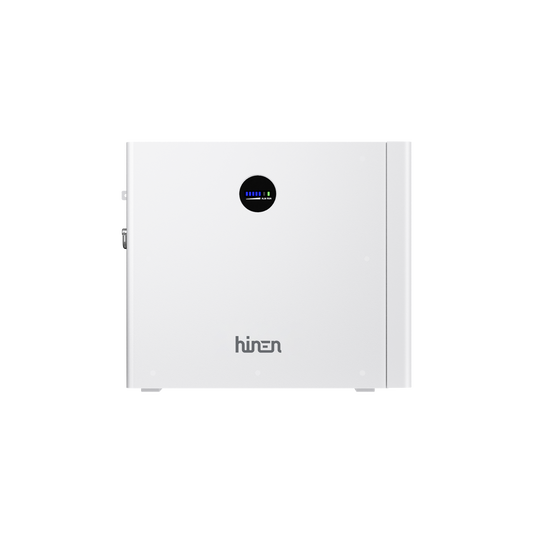
- 4.6 to 68.4 kWh
- Add modules later
- 10-year warranty
Hinen sells its batteries two ways: inside the A-series, a slim floor-standing cabinet that holds hybrid inverter, battery modules and controls together, or as separate modules beside a Hinen hybrid inverter. It suits new solar-and-battery installs, budget-led buyers who still want protection built into the hardware, and cold sites that need a heated pack.
By Kieron Taylor, Founder, Solar Select · Updated · 6 min read
The verdict
Well-specified hardware at a sharp price, inside a closed ecosystem. It makes most sense where the Hinen inverter is a fresh choice and the installer has commissioned the brand before.
Best for: New solar-and-battery installs wanting one slim cabinet, budget-led buyers who want safety features in the hardware itself, and cold-climate sites that benefit from the heated pack.
Look elsewhere if: You want to keep a working inverter from another brand, or would prefer that cloud registration was not tied to support.
The choice between all-in-one and separate modules, the module family, and whether backup accessories are included move a Hinen quote more than the cells do. Each is covered under quote factors below.
The 30-second take
- Two shapes, same cells. The A-series is the all-in-one. The B-series is the same battery modules sold on their own for a Hinen hybrid inverter.
- A long capacity ladder. Clean Energy Council listings run from 4.6 kWh to 68.4 kWh usable across low-voltage blocks, high-voltage stacks and a larger floor pack.
- Hinen inverters only. The compatibility statement lists Hinen’s own hybrids and nothing else, so on a retrofit the existing inverter comes out.
- Cloud registration is a support condition. Hinen’s service terms tie after-sales help to the system being registered online, unless an approved installer records a waiver.
- Safety and cold-weather hardware. The floor pack has an aerosol extinguisher and DC breaker built in, and the HW version adds battery heating for alpine and tableland sites.
Hinen at a glance
Each row is read from the source beside it, on the date it carries. Anything the manufacturer has not published is left out rather than guessed.
| Current models | B5000 / B5000-W (4.6 kWh usable), BH7700A (7 kWh usable), B8900M-HA (8.087 kWh usable), B14400-H / B14400-HW (13.68 kWh usable) cleanenergycouncil.org.au |
|---|---|
| Usable capacity | 4.6 to 68.4 kWh cleanenergycouncil.org.au |
| How it connects | Hybrid: works either way au.hinen.com |
| Add capacity later | Yes, modules can be added after install au.hinen.com |
| Inverter pairing | Own ecosystem only drive.google.com |
| Warranty | 10 years drive.google.com |
| Capacity at end of warranty | 80% guaranteed drive.google.com |
| CEC approved list | Yes, listed cleanenergycouncil.org.au |
| Who can install it | Manufacturer-certified installers only drive.google.com |
A-series or B-series: choose the shape first
Hinen’s Australian range looks wide, but it comes down to one decision. The A-series is an all-in-one: hybrid inverter, battery modules, control box and battery management inside a single slim cabinet that stands on the floor, available for single-phase and three-phase homes. The B-series is the same battery modules sold on their own, to sit alongside a separate Hinen hybrid inverter.
Because the cells are shared, the choice is mostly about the house. Does one tall cabinet fit where you want it, or would separate components suit the space better? Either route ends at the same manufacturer and the same support terms.
The modules come in three families on the Clean Energy Council list. The low-voltage B5000 is 4.6 kWh usable and is paralleled for more. The high-voltage BH7700A and B8900M-HA modules are 7 kWh and 8.087 kWh usable and are built to stack. The larger B14400 floor pack is 13.68 kWh usable, with listed configurations reaching 68.4 kWh. Each family scales by a different route, so “how many, of which” is a real question. Installers who know the range can answer it quickly, and you can find vetted Hinen installers in your state.
The closed ecosystem, and the cloud condition
Two things about Hinen are easy to miss on a quote, and both are written into the manufacturer’s own documents.
The first is inverter pairing. Hinen’s compatibility statement lists its own hybrid inverters only, and the warranty excludes systems assembled with other brands’ equipment. On a new install that simply removes a decision. On a retrofit it means the inverter already on your wall is replaced, and a well-prepared quote shows that swap as a separate line. A quote that puts a B-series module behind another manufacturer’s hybrid sits outside the warranty from the first day, however neat it looks.
The second is cloud registration. Hinen’s service commitment says the system has to be connected and registered online so that Hinen and the approved installer can monitor it, and treats that as a prerequisite for after-sales support. The same document lets an approved installer arrange a waiver. Either path is fine. What causes trouble is neither: a system handed over unregistered with nothing recorded.
- Ask the installer to register the system in your name before leaving, or to put the waiver in writing.
- Ask which app is being set up. Owners use the Hinen Solar app, and Hinen’s download page also carries Solarman manuals.
- Ask whether the installer is Hinen-certified. The warranty card calls for installation and commissioning by an authorised, certified dealer.
“On a Hinen system the registration step at handover is not admin. It is what keeps after-sales support switched on.”
The parts of a Hinen quote that swing
Hinen competes on value, so the interesting differences between quotes are in what has been specified, not in the cells.
- All-in-one or separates. The A-series bundles the inverter into the cabinet. A B-series quote needs a Hinen hybrid specified and itemised beside it.
- Module family and count. Low-voltage blocks, high-voltage stacks and the floor pack reach a given capacity by different routes.
- The heated HW pack. Worth having in a properly cold location, and worth a question if it turns up on a quote for a coastal house.
- Backup accessories. Hinen supplies the changeover switch and the current-transformer meter as separate items, and a hurried quote can leave them off.
- Backed-up circuits. Only circuits wired through the changeover switch stay on in an outage, so have them listed by name.
When you compare up to 3 Hinen quotes, look for those accessories first. A single cabinet still needs its backup wiring designed and quoted like any other system.
Safety hardware and the cold-climate option
Hinen leans on safety features that are uncommon at the value end of the market. The B14400 floor pack has an aerosol fire extinguisher and a DC breaker built into it, and Hinen describes layered protection across the range.
The B14400-HW variant adds battery heating. Lithium cells slow their charging and discharging in real cold to protect themselves, and a heated pack keeps working through it. For most Australian towns that is unnecessary. For alpine and tableland properties it addresses a genuine winter problem, and it is a fair reason to put Hinen on a shortlist there.
On paper, Hinen’s Australian warranty card gives its core module lines 10 years with 80% of usable capacity retained. Terms vary between module families, so read the card against the exact model on your quote.
Support, track record and the rebate check
Hinen is the energy arm of a listed Chinese electronics manufacturer, and a recent arrival here with a service office in North Sydney. Its service commitment offers round-the-clock remote technical help, and SolarQuotes owners who have needed support describe it as responsive and rate the brand highly. The installer base is still forming, which is why the installer’s own experience counts: ask how many Hinen systems they have handed over and who they deal with at Hinen Australia. If you are early in the process, see which Hinen installers cover your area and put those questions to each.
That experience shows up in one specific place. On an A-series unit the inverter and battery go through grid-connection approval together, and someone used to separate components can leave export settings and backup wiring partly configured on a single-cabinet system.
For the federal Cheaper Home Batteries discount, eligibility is set model by model. Hinen’s B5000, BH7700, B8900M and B14400 batteries are on the Clean Energy Council approved list, and the discount is worked out on the listed usable capacity of the model installed. Ask to see the exact quoted model on the current list, and have that string written on the quote.
Who should put Hinen on the shortlist
- New solar-and-battery builds, where a Hinen hybrid is a clean-sheet choice and not a forced swap.
- Households wanting one slim cabinet in place of separate inverter and battery boxes.
- Budget-conscious buyers who still want fire suppression and protection built into the hardware.
- Cold-climate properties, where the self-heating pack earns its place.
- Probably not a retrofit onto a healthy inverter from another brand, or a household that would rather not tie support to cloud registration.
The Clean Energy Regulator’s inspection program is a useful reminder of where battery problems start: of 1,278 home battery installations inspected from July 2025 to April 2026, more than 60% were classed as substandard, and the faults were overwhelmingly about installation. Solar Select can match you with up to 3 vetted installers at no charge. Get Hinen quotes from vetted installers in your state, and ask each one to walk you through registration and backup wiring before you sign.
How long would a Hinen take to pay for itself at your place?
Postcode, your bill, and whether the roof already has panels. About a minute, and the ten-year figure is yours before anyone asks for a phone number. Start with vetted Hinen installers in your state.
Read next
Sources
Every quantitative claim on this page traces to one of the sources below — government, manufacturer, or independent AU industry reference. Last verified 2026-09-17.
We use AI to help research and draft. Claims are traced to the sources below and dated. Where we haven’t got a source, we say so on the page — treat that as a starting point and do your own research.
General information only. It doesn’t take your circumstances into account and isn’t legal, financial, insurance or electrical advice. Rebates, tariffs, network rules and product terms change — confirm anything you plan to rely on with your installer, insurer, retailer or distributor, and see our terms.
- cleanenergycouncil.org.au — approved battery list
- dcceew.gov.au — Cheaper Home Batteries Program
- uts.edu.au — CER battery inspection findings, April 2026
- drive.google.com — Hinen Australia warranty card (warranty term and retained capacity)
- drive.google.com — Hinen inverter compatibility statement
- au.hinen.com — all-in-one residential systems
- au.hinen.com — home battery range
- au.hinen.com — downloads, warranty card and compatibility statement
- Hinen — Product Service Commitment (Australia)
- solarquotes.com.au — Hinen battery reviews
Postcode in, up to 3 vetted installers out. Free for homeowners, no obligation. All solar guides · Federal rebates · How it works
Filed under: Brand deep-dives