Brand deep-dives
Pytes battery review
Pytes: a battery that lets you pick the inverter, and the integration work that comes with it.
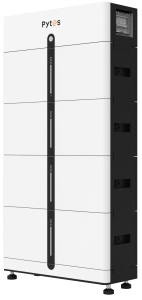
- 4.6 to 30.72 kWh
- Add modules later
- 10-year warranty
Pytes builds low-voltage lithium batteries meant to sit behind a hybrid inverter from a different manufacturer, in rack, tower and wall formats. It suits buyers who want to choose inverter and battery separately, and installers who have already made that exact pairing work.
By Kieron Taylor, Founder, Solar Select · Updated · 6 min read
The verdict
A flexible open battery that frees you from a single manufacturer’s inverter, in a format to suit most spaces. The pairing has to be engineered, so it rewards an installer who has commissioned that exact combination before.
Best for: Retrofits behind a hybrid inverter already chosen or installed, off-grid and shed banks, and owners who want to be able to swap the inverter one day and keep the battery.
Look elsewhere if: You want one manufacturer answerable for the whole system, a combined battery-inverter unit, or plenty of local owner feedback to go on.
The inverter pairing, the format and the number of units in parallel move a Pytes quote more than the battery cells do. Where the cost sits in a Pytes system, below, takes them one at a time.
The 30-second take
- Open by design. Pytes batteries are built to run with third-party hybrid inverters, and the company publishes compatibility product by product.
- Rack, tower or wall. The E-Box rack unit, the Pi LV1 stackable tower and the V-series wall models cover cupboards, sheds and ordinary retrofits; the register lists usable capacities from 4.6 kWh to 30.72 kWh.
- Firmware is the hidden step. The two devices must exchange data, and the versions on each side decide whether they do. Victron’s documentation for these batteries sets a minimum battery firmware.
- The warranty has a temperature clause. The Australian E-Box terms run 10 years to 70% capacity, and cover depends on the battery staying inside a stated ambient band.
- One supply channel. Australian stock arrives through one Victorian distributor with exclusive rights; have your installer show they buy from it.
Pytes at a glance
Each row is read from the source beside it, on the date it carries. Anything the manufacturer has not published is left out rather than guessed.
| Current models | E-Box 48100R (4.6 kWh usable), V5°α Plus (4.61 kWh usable), V10 (9.98 kWh usable), V12 (10.6 kWh usable), Pi LV1-1 (5.12 kWh usable), Pi LV1-6 (30.72 kWh usable) cer.gov.au |
|---|---|
| Usable capacity | 4.6 to 30.72 kWh cer.gov.au |
| Add capacity later | Yes, modules can be added after install pytesess.com |
| Inverter pairing | Works with other brands of inverter pytesess.com |
| Warranty | 10 years k2battery.com.au |
| Capacity at end of warranty | 70% guaranteed k2battery.com.au |
| CEC approved list | Yes, listed cer.gov.au |
| Who can install it | Any CEC-accredited installer k2battery.com.au |
What “open” means when battery and inverter come from different makers
Most home batteries sold in Australia are one half of a matched pair: buy the battery and you have also bought that brand’s inverter, app and upgrade path. Pytes takes the other route. Its low-voltage lithium batteries are designed to sit behind a hybrid inverter made by someone else, and the company publishes compatibility for each product instead of tying the battery to its own electronics. If that already sounds like your project, you can find vetted Pytes installers in your state.
The practical benefit shows up years later. When the inverter eventually needs replacing, the battery does not automatically go with it, which sets an open battery apart from a closed ecosystem over the long run. It also means the inverter can be selected for its own strengths instead of being whatever happens to match the battery.
The cost of that freedom is integration. Two products from two companies have to exchange data correctly, and nobody but your installer is responsible for making sure they do.
“An open battery gives you the choice of inverter, and hands your installer the job of making the two agree.”
Rack, tower or wall: the space picks the format
Pytes sells one idea in several enclosures. The E-Box is a server-rack unit that parallels into a bank, the natural fit for a plant room, a cupboard or a shed running off-grid. The Pi LV1 is the newer stackable line, a tower sized by how many modules go into it and aimed at conventional home installs. The V-series are one-piece wall units for places too awkward for either of the other formats.
On the Clean Energy Regulator’s register, the listed Pytes models run from 4.6 kWh usable for a single E-Box up to 30.72 kWh for the largest Pi LV1 tower, with the wall units in between. The architecture itself parallels well past that, into banks much bigger than any house calls for, which is why the brand turns up on rural and off-grid sites.
Decide the format before comparing quotes. The enclosures cannot be swapped for one another after the location is fixed, and two quotes for “a Pytes battery” can describe quite different hardware.
The firmware handshake no quote shows you
On a matched system the manufacturer has already tested battery against inverter. On an open pairing, part of that testing becomes your installer’s job. The two devices talk over a data link, and the firmware version on each side determines whether charging, state-of-charge reporting and protection limits behave as intended. Victron, for one, publishes a pairing guide for Pytes batteries that names the oldest battery firmware it will accept and the communications configuration to use.
The failure mode is subtle. A mismatched pair often still powers up and runs; it simply never charges properly, and the owner may not notice for months. The usual cause is a crew fluent in one half of the pairing and new to the other. None of this appears as a line on a quote, so it has to be asked about directly.
- Ask which exact inverter model is proposed, and whether the installer has commissioned it with a Pytes battery before.
- Ask which firmware versions both devices will be on at handover, and have that written on the commissioning paperwork.
- Check the inverter against the manufacturer’s current compatibility information for the specific Pytes model, not the brand in general.
- Note the warranty’s position on workmanship. It requires a licensed professional and explicitly excludes installer error, including faults in cabling or in the settings of connected equipment.
This is the strongest argument for choosing the installer before the hardware. When you compare up to 3 Pytes quotes from vetted installers, put the pairing question to each of them and compare the answers as closely as the totals.
Heat, the warranty band and a single distributor
The Australian warranty terms published for the E-Box series run for 10 years and to 70% of capacity when that period ends. They also make cover conditional on ambient temperature: the battery has to operate inside a stated band, and exposure above the upper limit voids it. In plenty of Australian locations a wall that faces west and takes the afternoon sun, or a sealed enclosure with a rack inside it, can reach that limit in summer. Shade and ventilation are therefore warranty decisions as much as performance ones, and they are made on installation day.
Supply is equally specific. Pytes reaches Australia through one exclusive distributor, a Victorian company, and a claim is lodged with whoever sold you the unit — distributor, reseller or installer. One channel keeps parts and support coherent, and it concentrates dependence on one company. An installer who cannot show the stock was bought from that distributor is a reason to pause, because a unit sourced elsewhere complicates any later claim.
Pytes also has a smaller installed base here than the long-established open-battery names, which is one more reason the installer’s own history with the product matters.
Where the cost sits in a Pytes system
Because the battery and inverter are separate purchases, a Pytes quote has more moving parts than a matched system. These are the ones that shift the total.
- The inverter. It is a real second decision here. A quote that reuses a suitable hybrid inverter you already own looks very different from one that supplies a new one.
- The format. Rack, tower and wall units suit different spaces and involve different mounting and enclosure work.
- Units now and headroom later. How many are paralleled on day one, and what the chosen inverter lets you add. The inverter is usually the binding limit on expansion, not the battery.
- Compatibility confirmation. Verifying firmware between this battery and that inverter is real work, and a careful installer allows time for it.
- Siting. A position that stays within the warranty’s temperature band may mean a longer cable run or added ventilation.
The federal rebate is assessed on the specific model. A Pytes battery qualifies on its own model string, not as part of a matched system, so have the installer point to that precise string on the Clean Energy Council’s current approved list before you sign.
Who should put Pytes on the shortlist
- Buyers who want to choose inverter and battery separately, each on its merits.
- Retrofits behind a hybrid inverter that is already installed or already decided on, provided it appears in Pytes’ compatibility information.
- Off-grid properties and sheds, where a bank of rack units suits the space and capacity needs run past household scale.
- Owners thinking a decade ahead, who want a future inverter swap to leave the battery in place.
- Probably not the household that wants a single manufacturer accountable for everything, a combined unit, or plenty of local owner reviews to lean on.
Whatever the brand, installation quality decides most outcomes: the Clean Energy Regulator inspected 1,278 home battery installations between July 2025 and April 2026 and classified more than 60% as substandard. On an open system that risk sits squarely in the pairing, so experience with this exact combination matters more than the badge on the battery. Solar Select can match you with up to 3 vetted installers. From there, see which vetted installers fit Pytes batteries near you and find out how many of these pairings each has commissioned.
How long would a Pytes take to pay for itself at your place?
Postcode, your bill, and whether the roof already has panels. About a minute, and the ten-year figure is yours before anyone asks for a phone number. Start with vetted Pytes installers in your state.
Read next
Sources
Every quantitative claim on this page traces to one of the sources below — government, manufacturer, or independent AU industry reference. Last verified 2026-09-17.
We use AI to help research and draft. Claims are traced to the sources below and dated. Where we haven’t got a source, we say so on the page — treat that as a starting point and do your own research.
General information only. It doesn’t take your circumstances into account and isn’t legal, financial, insurance or electrical advice. Rebates, tariffs, network rules and product terms change — confirm anything you plan to rely on with your installer, insurer, retailer or distributor, and see our terms.
- cleanenergycouncil.org.au — approved battery list
- dcceew.gov.au — Cheaper Home Batteries Program
- uts.edu.au — CER battery inspection findings, April 2026
- Pytes Australia — product range and Australian supplier
- Shanghai Pytes Energy — Australian terms of warranty (E-Box series)
- Pytes — V5 low-voltage battery specifications
- Victron Energy — Pytes battery compatibility documentation
- Clean Energy Regulator — CEC approved solar batteries register
Postcode in, up to 3 vetted installers out. Free for homeowners, no obligation. All solar guides · Federal rebates · How it works
Filed under: Brand deep-dives