Brand deep-dives
Redback battery review
Redback: a whole hybrid system wired before it arrives, and a warranty that needs your internet.
- 4.864 to 33.25 kWh
- Add modules later
- 10-year warranty
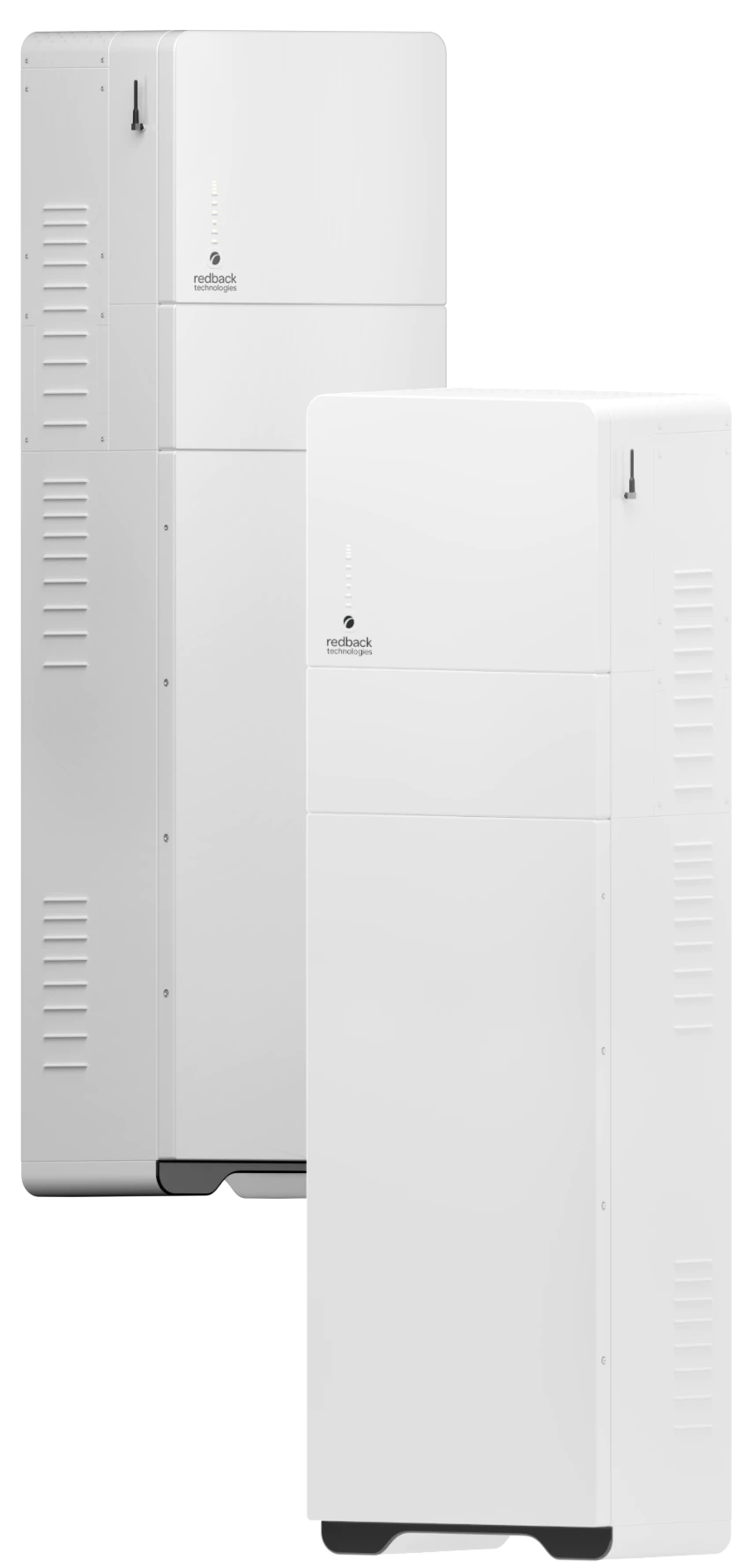
Redback does not sell a battery on its own. It sells a Brisbane-engineered hybrid inverter with a cabinet of battery units underneath, switchgear wired before delivery and load control included. It suits households that want one Australian company answerable for the lot, and it rules out keeping the inverter you already own.
By Kieron Taylor, Founder, Solar Select · Updated · 6 min read
The verdict
A tightly integrated Australian hybrid system with load control and pre-wired switchgear built in, backed by a ten-year battery warranty. It is a closed ecosystem whose warranty leans on a live cloud connection, from a company that has been through administration and a change of owner.
Best for: New solar-and-battery installs where having one Australian company answer for inverter, battery, switchgear and software is worth more than mix-and-match freedom.
Look elsewhere if: You want to keep a working inverter from another brand, your property is off-grid, or you would prefer a warranty that does not hinge on an internet link.
The inverter family, the number of battery units in the cabinet and the backup and load-control wiring move a Redback quote more than anything else. The section on quote factors below walks through each.
The 30-second take
- A system, not a battery. Redback supplies the hybrid inverter, the battery cabinet, the switchgear and the software as one product, and its warranty shuts out inverters and battery modules from other makers.
- Three families. The Smart Hybrid G3 sits on a low-voltage enclosure of stackable packs; the Hybrid Battery Max and the three-phase series use high-voltage cabinets. Redback’s units on the Clean Energy Council list span 4.864 kWh to 33.25 kWh of usable capacity.
- A ten-year battery warranty that commits to at least 70% of capacity at the end, conditional on a stable connection to Redback’s cloud.
- Smart Load Control comes standard. The inverter steers named circuits between solar, battery and grid, which pays off only when worthwhile loads are wired to it.
- The company has a history worth raising. SolarQuotes records a voluntary administration followed by a new owner, so ask any installer how a warranty claim runs today.
Redback at a glance
Each row is read from the source beside it, on the date it carries. Anything the manufacturer has not published is left out rather than guessed.
| Current models | RED-R1-5000LV (4.864 kWh usable), RED-R2-16KLV (15.2 kWh usable), RED-P1-BE14HV (13.3 kWh usable), RED-P1-BE21HV (19.95 kWh usable), RED-P1-BE28HV (26.6 kWh usable), RED-P1-BE35HV (33.25 kWh usable) cleanenergycouncil.org.au |
|---|---|
| Usable capacity | 4.864 to 33.25 kWh cleanenergycouncil.org.au |
| How it connects | Hybrid: works either way redbacktech.com |
| Add capacity later | Yes, modules can be added after install digital.redbacktech.com |
| Inverter pairing | Own ecosystem only digital.redbacktech.com |
| Warranty | 10 years digital.redbacktech.com |
| Capacity at end of warranty | 70% guaranteed digital.redbacktech.com |
| CEC approved list | Yes, listed cleanenergycouncil.org.au |
| Who can install it | Any CEC-accredited installer digital.redbacktech.com |
What you are buying: an inverter with a battery underneath
Most battery brands sell a box that an installer pairs with an inverter. Redback sells the whole assembly: an Australian-engineered hybrid inverter on top, a cabinet of battery units below, the switchgear already wired and the control panel assembled at the factory. The practical effect is less hand-wiring on install day and a single company responsible for every layer. If that appeals, you can find vetted Redback installers in your state.
The range splits three ways. The Smart Hybrid G3 is the single-phase entry point, built around a low-voltage enclosure that holds stackable packs. The Hybrid Battery Max is the bigger single-phase option and moves to a high-voltage cabinet, with a separate management module sitting over the battery units. The three-phase series takes the same high-voltage approach into larger homes and small commercial sites. On the Clean Energy Council’s approved list, Redback’s battery units currently run from 4.864 kWh of usable capacity for the smallest low-voltage pack to 33.25 kWh for the largest high-voltage enclosure.
The battery warranty runs for ten years and commits to at least 70% of capacity remaining at the end of the term. The company standing behind it is Australian, and the document calls for installation by an accredited installer.
The warranty has an internet clause
Here is the part buyers rarely think to ask about. Redback commissions, monitors and diagnoses its systems through its own cloud, and the warranty conditions call for a stable connection to that cloud. A system that drops offline is therefore more than a blank screen in the app. It is a warranty exposure.
The hardware gives the installer three ways to connect: household Wi-Fi, a wired Ethernet run, or an optional 4G module. In a home where the signal at the meter box is weak, Wi-Fi is the most fragile of the three. Ask which path the quote assumes, and ask the installer to test the link from Redback’s portal before they pack up.
Two further exclusions sit alongside that one. Off-grid properties fall outside the warranty altogether, and so do third-party inverters and battery modules. Redback is a closed ecosystem by design: on a new build that removes a decision, and on a retrofit it means your current inverter comes out. That removal should appear on the quote as its own line, not disappear into the system total.
“On a Redback system, a weak Wi-Fi signal is a warranty question before it is a monitoring one.”
Registered installers, export schemes and where the cabinet goes
Redback runs a registered-installer process through its portal. A crew outside it can still mount and wire the hardware, but it cannot reach the remote tools for commissioning, checking the meter and correcting a reversed CT. Those tools are a large part of why the pre-wired design saves time on site, so an unregistered installer gives up much of the advantage you are paying for. When you compare up to 3 Redback quotes, ask each installer whether they are registered.
Grid connection is the other place experience shows. Several Australian networks run dynamic-export or backstop schemes, and Redback publishes commissioning procedures for them. An installer meeting those settings for the first time can hand over a system with export limits or backstop behaviour set wrongly. Ask whether they have commissioned a Redback on your network’s scheme before.
Placement matters too. The high-voltage battery cabinet has a lower ingress rating than the inverter above it, plus a defined operating temperature window. A spot picked because the cable run is short, when a shaded and sheltered wall was available, costs durability.
Why Redback quotes differ
Because the inverter is part of the product, two Redback quotes can differ for reasons that have nothing to do with the installer. These are the line items that move a Redback total.
- Inverter family. G3, Max or three-phase fixes the enclosure type and the most storage the system can ever hold, so read that line first.
- Battery units now versus room later. Ask how many units are fitted today and how many spare positions the cabinet has.
- Backup and Smart Load Control circuits. Each should be listed by name. “Backup included” with no circuit list means the design work has not been done.
- The cloud path. A wired Ethernet run or the optional 4G module is a line item worth having where household Wi-Fi is unreliable.
- Cabinet location. A sheltered, shaded position can mean a longer cable run, and that is the right trade.
- Enclosure size and the rebate. The federal battery discount has stepped down by capacity band since 1 May 2026, so a larger enclosure earns the top rate on only part of its capacity.
Rebate eligibility is decided model by model, not brand by brand. Before signing, ask the installer to show you the exact enclosure or pack named on your quote on the Clean Energy Council’s current approved list.
Living with it: load control, the app and the company behind it
Smart Load Control is the feature owners on SolarQuotes praise most. Instead of simply charging and discharging, the inverter decides through the day which loads run from solar, battery or grid. Households that give it worthwhile circuits to manage get noticeably more from the system than those that leave the feature idle.
Day to day you live in the MyRedback app and web portal, which SolarQuotes reviewers generally like. The critical reviews there concentrate on software glitches and slow support, not on the hardware. In a blackout the system carries whatever is wired to its dedicated backup output, which is not the whole house by default.
Redback describes the range as compatible with virtual power plants run by major energy retailers. VPP plans are written around named hardware, so confirm that your retailer’s plan lists the inverter family on your quote.
One more thing belongs in the conversation. SolarQuotes records that Redback entered voluntary administration and came out of it under a new owner, and owners who bought during that period describe delayed claims. Redback has since released a new generation of hybrid systems and published a warranty-delay resolution. Ask the installer how a claim runs now and who at Redback picks it up.
Who should shortlist Redback
- New solar-and-battery installs where one Australian company answering for inverter, battery, switchgear and software is the priority.
- Homes on dynamic-export or backstop networks, provided the installer has commissioned Redback on that scheme before.
- Households that will use load control and can name the circuits they want managed.
- VPP joiners whose retailer lists the quoted inverter family.
- Probably not a retrofit where a healthy inverter from another brand is staying, an off-grid property, or a buyer who wants an unbroken corporate history behind a ten-year warranty.
Whatever the badge, workmanship decides the outcome. The Clean Energy Regulator inspected 1,278 home battery installations between July 2025 and April 2026 and classified more than 60% as substandard. With Redback the installer also controls your cloud link, your export settings and your circuit list, so their experience counts twice. Solar Select can match you with up to 3 vetted Redback installers; ask each one how many Redback systems they have commissioned on your network.
How long would a Redback take to pay for itself at your place?
Postcode, your bill, and whether the roof already has panels. About a minute, and the ten-year figure is yours before anyone asks for a phone number. Start with vetted Redback installers in your state.
Read next
Sources
Every quantitative claim on this page traces to one of the sources below — government, manufacturer, or independent AU industry reference. Last verified 2026-09-17.
We use AI to help research and draft. Claims are traced to the sources below and dated. Where we haven’t got a source, we say so on the page — treat that as a starting point and do your own research.
General information only. It doesn’t take your circumstances into account and isn’t legal, financial, insurance or electrical advice. Rebates, tariffs, network rules and product terms change — confirm anything you plan to rely on with your installer, insurer, retailer or distributor, and see our terms.
- cleanenergycouncil.org.au — approved battery list
- dcceew.gov.au — Cheaper Home Batteries Program
- uts.edu.au — CER battery inspection findings, April 2026
- Redback Technologies — product range and warranty
- Redback — Product Warranty Batteries vF112
- Redback — RED-P1-BE35HV series data sheet
- SolarQuotes — Redback Technologies battery reviews
Postcode in, up to 3 vetted installers out. Free for homeowners, no obligation. All solar guides · Federal rebates · How it works
Filed under: Brand deep-dives