Brand deep-dives
sonnen battery review
sonnen: a high-end battery that keeps your existing inverter, and a capacity you choose once.
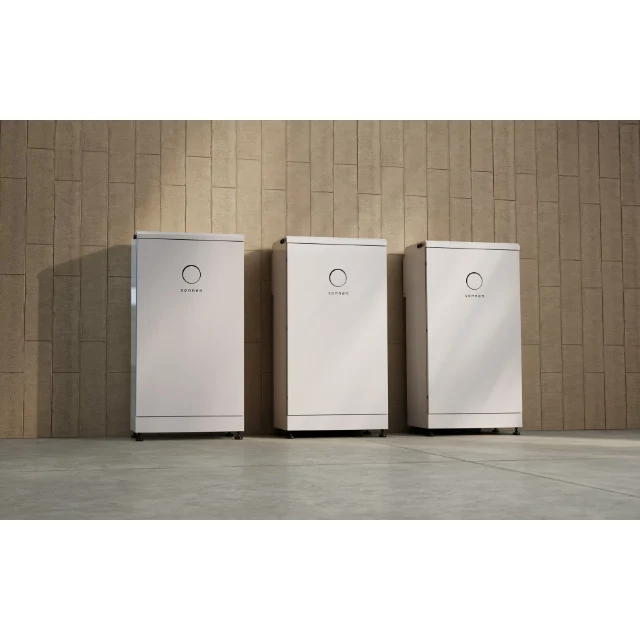
The sonnenBatterie Evo is an AC-coupled lithium iron phosphate battery from a company that sells German engineering and a long European field record, housed in an enclosure designed for outdoor life in Australia and New Zealand. It is aimed at homes with good solar on the roof today. It is a compact, fixed-size product, so the sizing conversation happens at the start and not over several years.
By Kieron Taylor, Founder, Solar Select · Updated · 6 min read
The verdict
A considered high-end product that earns its place on retrofits, where keeping a good solar inverter is worth more than a small efficiency gain. It asks you to get the size right on day one, because it does not expand the way modular stacks do.
Best for: Homes with sound existing solar, an outdoor mounting position, and evening use that fits comfortably within the Evo’s capacity.
Look elsewhere if: You need a large or progressively expandable system, you are building solar and storage together from scratch, or you will decide purely on capacity for the money.
Whether the existing inverter stays, where the unit is mounted and what backup covers move a sonnen quote. The quote-factor section further down sets out each one.
The 30-second take
- AC-coupled. The Evo contains an inverter of its own and joins the house at the switchboard, so your current solar inverter stays in service.
- The trade-off is efficiency. Energy takes a longer path into storage than in a DC-coupled hybrid, which matters most when solar and battery are being installed together.
- Sized once. Capacity sits in a narrow band and does not grow module by module, so the evening-load calculation has to be done properly up front.
- Built for outdoors. The enclosure was designed for local conditions, though shade and airflow still decide how the battery ages.
- High-end positioning. You are buying durability, software and a clean retrofit, not the most capacity for the money.
What AC coupling changes on a retrofit
Most batteries sold in Australia are DC-coupled: they hang off a hybrid inverter, and fitting one to an older solar system often means removing an inverter that still works. sonnen takes the other route. The Evo contains an inverter of its own and joins the house at the switchboard, on the AC side. Your panels keep feeding their original inverter exactly as before, and nothing on the solar side is swapped out.
For a household with a well-performing solar system, that is the main reason to consider it. Working equipment stays where it is, and the battery simply arrives next to it.
There is a longer-horizon benefit as well. The battery does not depend on the solar inverter, so its useful life is separate from that unit’s. When the solar inverter reaches the end of its service, or the array is replaced, the Evo can stay and work with whatever comes next. With ageing solar that is worth weighing; with recently installed solar it is a distant consideration. If a retrofit is your situation, you can find vetted sonnen installers in your state and ask how they would integrate it with the inverter you own.
The efficiency trade, and when to make the installer argue it
AC coupling is not free. Solar energy leaves the panels as DC, is converted to AC by the solar inverter, and is then converted back to DC to be stored. A DC-coupled hybrid skips part of that journey, so on the round trip it loses a little less.
On a retrofit the loss is a fair exchange for keeping working equipment. When solar and storage are being specified together it is a genuine question: a hybrid inverter would generally be the more efficient design, and an AC-coupled battery needs a reason to be there. Good reasons exist — outdoor hardware, software, a preference for the brand’s engineering record — but they should be stated by the installer and weighed, not assumed.
A useful way to put it to them: is AC coupling solving a problem this house has, or is it a retrofit feature being sold to a home that has nothing to retrofit?
“AC coupling is the right answer to a specific question. On a new build, make sure somebody has actually asked it.”
One capacity decision, made at the start
The big modular brands let you begin small and bolt on more later. The Evo is a different kind of product: its capacity sits in a narrow band suited to a typical evening, and sonnen’s range is not aimed at very large storage or at growing year by year. A plan that relies on adding capacity down the track is a weak one here.
That puts weight on the load calculation. What counts is consumption after sunset, not the daily total. Heavy air conditioning, home EV charging or a pool can each push evening demand past what this battery holds. Ask to see the evening-load numbers behind the recommendation, and mention anything that will change the picture — a planned electric car, a renovation, a switch to heat-pump heating — before the design is fixed.
The benefit of a fixed size is fewer decisions. There is one mainstream product to understand, and the conversation can move quickly to placement and backup. To test the sizing with someone who fits them, compare sonnen quotes from up to 3 vetted installers.
Rated for outdoors is not the same as happy in full sun
The Evo’s enclosure was designed for outdoor life in this part of the world, and that is a real point of difference for homes without garage space. An ingress rating, though, describes protection from dust and water. It does not protect the cells from a wall that bakes through a summer afternoon, and every lithium battery ages faster when it runs hot.
Ask exactly which wall is proposed, what shades it after midday and how air moves around the unit. The same precision applies to backup. A big-name badge does not mean the house keeps running in a blackout: the quote should state whether backup is part of the configuration and name the circuits it will supply.
What sets the size of a sonnen quote
sonnen presents itself as a provider of engineering, long service life and continuing energy management, and it is not trying to be the cheapest way to buy capacity. Within that, these are the things that change a quote.
- Whether the existing solar inverter stays. Keeping it is where an AC-coupled battery justifies itself.
- Indoor or outdoor mounting, and any work needed to give an outdoor position shade and airflow.
- How the fixed capacity lines up with your evening load, since there is no cheap way to correct it later.
- Backup scope — which circuits, and whether backup features in the quoted configuration at all.
- Whether the precise model is currently approved.
The federal rebate is tied to the specific model, not to the brand. Have the installer show you the quoted sonnen model in the Clean Energy Council’s list of approved batteries before you rely on the rebate in any comparison.
It is also worth asking which tariff you will be on after installation. sonnen’s software chooses the moments to charge, discharge and export according to your habits and your pricing. Where peak and off-peak rates sit far apart, that judgement is worth paying for. Where the rate is flat and the household routine is simple, a plainer battery will deliver nearly the same result.
Where sonnen belongs on a shortlist
- Good existing solar with an inverter worth keeping.
- An outdoor install where hardware designed for local conditions matters.
- Evening use that fits the Evo’s capacity with room to spare.
- Owners who weight engineering record and software above headline capacity.
- Probably not a home installing solar and storage together, a household planning to expand in stages, or a buyer who compares on capacity for the money alone.
sonnen has been in the field in Europe for longer than most names on the Australian market, while fewer of its units, and fewer installers familiar with them, are found here than is the case for the volume brands. That makes the installer’s own experience with the product worth checking: ask how many Evo units they have fitted and where they mounted them. Solar Select can introduce up to 3 vetted installers, and you can see sonnen battery installers covering your area to begin.
How long would a sonnen take to pay for itself at your place?
Postcode, your bill, and whether the roof already has panels. About a minute, and the ten-year figure is yours before anyone asks for a phone number. Start with vetted sonnen installers in your state.
Read next
Sources
Every quantitative claim on this page traces to one of the sources below — government, manufacturer, or independent AU industry reference. Last verified 2026-09-17.
We use AI to help research and draft. Claims are traced to the sources below and dated. Where we haven’t got a source, we say so on the page — treat that as a starting point and do your own research.
General information only. It doesn’t take your circumstances into account and isn’t legal, financial, insurance or electrical advice. Rebates, tariffs, network rules and product terms change — confirm anything you plan to rely on with your installer, insurer, retailer or distributor, and see our terms.
- cleanenergycouncil.org.au — approved battery list
- dcceew.gov.au — Cheaper Home Batteries Program
- sonnen Australia
- SolarQuotes — battery brand reviews
Postcode in, up to 3 vetted installers out. Free for homeowners, no obligation. All solar guides · Federal rebates · How it works
Filed under: Brand deep-dives