Brand deep-dives
Victron battery review
Victron: a complete off-grid power ecosystem, and a battery the federal discount does not cover.
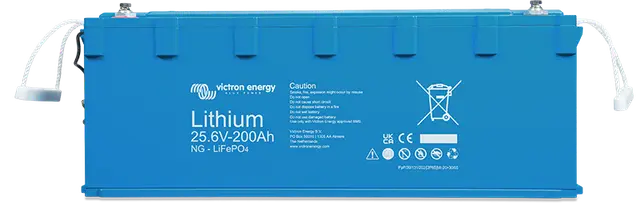
- 3-year warranty
Victron Energy, from the Netherlands, builds inverter/chargers, solar charge controllers, monitoring gear and batteries for properties beyond the grid, boats and vehicles, and its reputation in that work is formidable. On a grid-connected house the picture changes: Victron batteries are absent from the approved battery list, so the usual design runs Victron electronics with another manufacturer’s listed battery.
By Kieron Taylor, Founder, Solar Select · Updated · 6 min read
The verdict
Excellent equipment for marine, vehicle and off-grid power, built up from individual components by a dealer. Victron batteries are absent from the approved battery list, so on a grid-connected home the battery does not attract the federal discount, and the standard lithium warranty is 3 years.
Best for: Properties beyond the network, boats, caravans and hands-on owners, plus grid-connected homes running a Victron inverter/charger with another manufacturer’s listed battery.
Look elsewhere if: One cabinet, one long warranty and the federal discount on the battery itself are what you are after.
The job the system has to do, whose battery is in the design and the number of components move a Victron quote more than any single box does. The section on why two Victron quotes rarely match covers each.
The 30-second take
- Built for life beyond the grid. Victron’s catalogue is aimed at off-grid homes, caravans, buses, boats and remote sheds, and it states battery capacity in amp-hours, the unit direct-current system designers work in.
- The federal discount does not reach the battery. The approved-battery register kept by the Clean Energy Regulator lists no Victron model, so a Victron battery does not attract the Cheaper Home Batteries discount.
- The common answer is a mixed system. Installers often run a Victron inverter/charger with an approved-list battery made by someone else, so the owner gets Victron electronics without giving up the discount.
- Lithium carries a 3-year standard warranty. That is shorter than the term on Victron’s own power electronics, and it can be lengthened at extra cost.
- The dealer is part of the product. Separate components are chosen and put together by a dealer, and warranty claims go back to that same business.
Victron at a glance
Each row is read from the source beside it, on the date it carries. Anything the manufacturer has not published is left out rather than guessed.
| Current models | Lithium NG Battery, Lithium SuperPack NG, Lithium Battery Smart, Lithium SuperPack, Peak Power Pack victronenergy.com.au |
|---|---|
| Warranty | 3 years victronenergy.com.au |
| CEC approved list | Not listed cer.gov.au |
What Victron sells: a parts list, not a cabinet
A packaged home battery arrives as one enclosure with one datasheet. A Victron system arrives as a parts list: an inverter/charger, one or more solar charge controllers, a monitoring device, the battery bank and, depending on the battery chosen, a battery management system bought as its own item. The installer selects each piece and configures them to talk to one another. That explains both the brand’s reputation and its variability — identical components can produce a superb system or a mediocre one.
The current battery line-up on Victron’s Australian site is the Lithium NG Battery, the Lithium SuperPack NG, the Lithium Battery Smart, the Lithium SuperPack and the Peak Power Pack, alongside a lead-acid catalogue that is still sizeable. The SuperPack models carry their management electronics and safety switch inside the case, which suits vehicle and marine retrofits. The Lithium Battery Smart is the modular option and needs a Victron battery management system installed with it.
One detail on the product pages shows who the range was designed for. Capacity is given in amp-hours for a stated system voltage, the way a designer sizes a boat or a remote shed, where household brands use kilowatt-hours, the unit on a power bill. A Victron parts list and a packaged home battery therefore cannot be compared line against line. If this is the kind of system you need, you can find installers who work with Victron systems in your state.
The approved-list question every grid-connected buyer should ask first
The Cheaper Home Batteries Program only discounts hardware that appears on the Clean Energy Council approved battery list. When the Clean Energy Regulator’s register of approved batteries was checked in September 2026, it held no Victron battery. A quote for a grid-connected home that specifies a Victron battery therefore does not attract the federal discount, and the moment to learn that is before a contract is signed, not when the claim is lodged.
There is a wrinkle that catches people out. Victron’s MultiPlus-II inverter/charger does hold an Australian approval, but on the inverter list, which is a separate register. An approved inverter does nothing for the eligibility of the battery wired to it.
That is why many installers design a mixed system: a Victron inverter/charger running an approved-list battery from a different manufacturer. The owner keeps Victron’s electronics and monitoring, and the discount remains in reach, provided the pairing is a supported one and the installation satisfies the rest of the program’s rules.
- Ask to see the exact battery model on the current Clean Energy Council approved list. Eligibility is decided model by model, never by badge, so the model code printed on the quote is what has to match.
- Ask what the design does to your rebate if the battery quoted is a Victron one, and get the answer in writing.
- Ask whether the inverter and battery pairing is a supported one wherever a second brand’s battery is used.
On a property with no grid connection, a boat or a bus, the rebate question falls away entirely — and that is the territory where Victron is strongest.
“An approved inverter confers nothing on the battery beside it. The model on the quote has to be on the battery list itself.”
Three years on lithium, and a dealer instead of a service desk
Victron’s Australian warranty page gives its lithium batteries a standard warranty of 3 years. That sits well below the term packaged home batteries usually carry, and below the standard term Victron puts on its own power electronics. The battery term can be lengthened by paying a percentage of what the equipment cost, so price the extension as a line item when you compare quotes.
A Victron quote usually contains several boxes, and they do not all carry the same term. Have the installer write the warranty period beside each item so nobody assumes one figure covers the lot.
Claims and repairs are handled by the supplying dealer, with Victron’s international repair network behind them. Homeowners do not ring a national call centre. With a long-established dealer this arrangement works well; if the dealer closes, or was never a genuine Victron dealer, you may be left without an obvious party to claim against. Ask how long the business has been a Victron dealer and who would handle a fault late in the warranty period. You can compare Victron dealers and installers near you before committing to one.
Why two Victron quotes for the same site rarely match
Because the system is a bill of materials, two Victron quotes for the same property can differ widely without either being wrong. These are the factors doing the work.
- The job description. Fully off-grid, backup-only and grid-connected designs are different systems. Settle which one you are buying first, because it also settles whether Victron belongs on the shortlist at all.
- Whose battery is in it. A Victron battery bank and an approved-list battery from a different manufacturer are different purchases, and the federal program treats them differently.
- The battery management system. The modular lithium line needs one as a separate component. Leaving it out or undersizing it creates a safety issue and a warranty issue, so check it appears as its own line.
- How many inverter/chargers and charge controllers. The design decides the count, and every one is a separate product to buy and configure.
- The dealer behind it. Design, commissioning and warranty handling all sit with the supplying dealer, and that support is part of what you are paying for.
For backup and off-grid designs, one more input drives the total: the load profile. A system sized against metered consumption will differ from one sized on a rough estimate, and the estimate is the one that lets you down in the first run of bad weather. Ask to see the working.
Monitoring, backup and generators
Victron’s monitoring is free and goes far deeper than the app bundled with a typical home battery. VictronConnect is the phone app and Victron Remote Monitoring is the browser portal, each showing what the individual components are doing. For an owner-operator who wants to watch and tune every parameter, this is a large part of the appeal. For someone who wants a simple screen and no decisions, it is more than they need.
Backup and off-grid running is what the inverter/chargers are built to do, and they cope with generator input and multiple charging sources better than most household equipment. Whether that becomes a good blackout system depends on the design work: the circuits covered, the loads assumed at design time, and how well the battery bank matches the outage you expect.
Who Victron is for
- Properties beyond the network, where the rebate question does not arise.
- Caravans, buses, boats and remote sheds — the work this equipment was designed around.
- Hands-on owners who prefer detailed data and control to a simplified app.
- Grid-connected households that want Victron electronics and the discount, achieved with a Victron inverter/charger and another manufacturer’s listed battery.
- Sites with a generator, mixed charging sources or out-of-the-ordinary loads, where a modular system justifies its complexity.
- Probably not a suburban home that wants one cabinet, one warranty document, the longest battery warranty on offer and the federal discount on the battery itself.
With Victron more than most brands, the installer is the product. One business chooses, sizes and tunes the components, and the same business is your warranty counterparty. Fluency in packaged home batteries does not guarantee fluency in this ecosystem. Ask how many Victron systems the installer has designed and ask to see one, then compare up to 3 Victron quotes from vetted installers so the designs can be judged side by side.
How long would a Victron take to pay for itself at your place?
Postcode, your bill, and whether the roof already has panels. About a minute, and the ten-year figure is yours before anyone asks for a phone number. Start with vetted Victron installers in your state.
Read next
Sources
Every quantitative claim on this page traces to one of the sources below — government, manufacturer, or independent AU industry reference. Last verified 2026-09-17.
We use AI to help research and draft. Claims are traced to the sources below and dated. Where we haven’t got a source, we say so on the page — treat that as a starting point and do your own research.
General information only. It doesn’t take your circumstances into account and isn’t legal, financial, insurance or electrical advice. Rebates, tariffs, network rules and product terms change — confirm anything you plan to rely on with your installer, insurer, retailer or distributor, and see our terms.
- cleanenergycouncil.org.au — approved battery list
- dcceew.gov.au — Cheaper Home Batteries Program
- Victron Energy Australia — batteries
- Victron Energy Australia — warranty and repairs
- Victron Professional — Australian CEC approval for MultiPlus-II
- Clean Energy Regulator — CEC approved solar batteries register
Postcode in, up to 3 vetted installers out. Free for homeowners, no obligation. All solar guides · Federal rebates · How it works
Filed under: Brand deep-dives