Market data
Rooftop solar is now 15.8% of Australia’s electricity supply
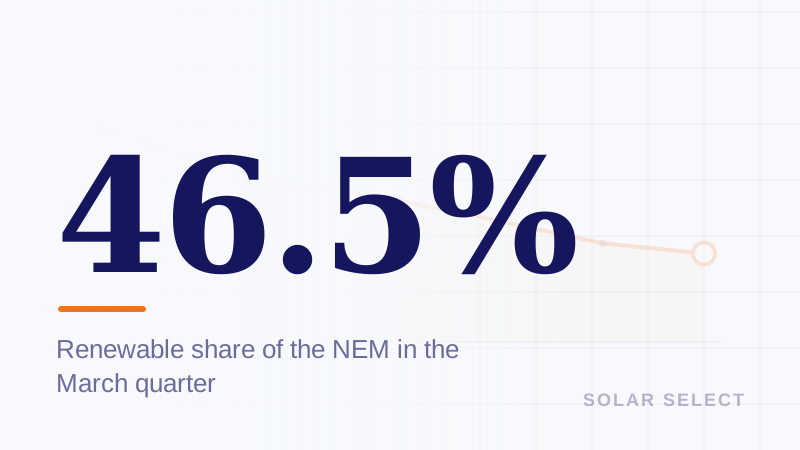
AEMO’s first-quarter data put renewables at 46.5% of the National Electricity Market — a Q1 record — with household rooftops supplying more than a seventh of everything.
· 5 min read · Last verified 2026-08-11
The 30-second take
- Renewables supplied 46.5% of National Electricity Market generation in Q1 2026, a new first-quarter high, up from 42.5% in Q1 2025.
- Rooftop solar averaged 4,090MW across the quarter and accounted for 15.8% of total supply.
- Both grid-scale and distributed solar broke quarterly generation records in the same period.
- Rooftop solar is now infrastructure. It is owned by millions of households and coordinated by nobody.
- That is why export rules, tariff reform and battery incentives keep changing — the grid is catching up to what households already built.
What AEMO reported
The Australian Energy Market Operator publishes a Quarterly Energy Dynamics report covering the National Electricity Market — the interconnected grid spanning Queensland, New South Wales, the ACT, Victoria, South Australia and Tasmania.
For the first quarter of 2026, renewable generation supplied 46.5% of NEM generation. That is a new Q1 high and a substantial jump from 42.5% in the same quarter of 2025.
Within that, rooftop solar averaged 4,090 megawatts across the quarter, accounting for 15.8% of total supply. Grid-scale and distributed solar both set quarterly generation records.
Why the rooftop number is the interesting one
A grid-scale solar farm is a planned asset. Someone modelled the site, secured a connection, financed it, and built it to a schedule. The system operator knows exactly where it is and what it will do.
Rooftop solar is the opposite. It is millions of small installations, added one household at a time, on the basis of millions of separate financial decisions. Nobody planned the aggregate. Nobody controls the aggregate. And it is now supplying more than a seventh of the electricity in the largest grid in the country.
That is a genuinely unusual piece of infrastructure, and it explains most of the policy churn in this sector.
“Rooftop solar is national-scale infrastructure that nobody planned and nobody controls.”
What it explains about the rule changes
If you have wondered why export tariffs, feed-in rates, battery incentives and connection rules seem to change every year, this data is the reason.
A grid built to move power in one direction — from a small number of large generators out to households — is now receiving a large and variable inflow from the edges during the middle of every sunny day. The rules governing that were written for a world that no longer exists.
So the changes fall into a consistent pattern: reduce the incentive to export at midday, increase the incentive to store, increase the incentive to export or consume in the evening peak.
- Two-way export pricing in NSW and SA charges midday export and rewards evening export.
- Feed-in tariffs have fallen across most states as midday energy became abundant.
- Battery rebates exist substantially to shift that midday surplus into the evening.
- Virtual power plants aggregate household batteries into something the market can actually dispatch.
None of that is hostile to solar owners. It is the system trying to make use of what households built faster than anyone expected.
What it means for a household deciding now
The practical translation is that the value of a rooftop system has shifted from what you can sell to what you can avoid buying and when you can use it.
When rooftop solar was rare, exporting was valuable because the energy was scarce relative to demand. Now that rooftop solar is 15.8% of supply in the first quarter of the year, midday energy is the most abundant commodity in the market — and abundant things are cheap.
That does not make solar a worse investment. It makes self-consumption, load shifting and storage the parts of the equation that carry the return, and it makes the export figure on a sales projection much less meaningful than it used to be.
What this means for you
If you’re a homeowner
- Judge a quote on self-consumption and avoided grid purchases, not on an optimistic export revenue line. Midday energy is abundant and priced accordingly.
- Shifting load into daylight hours is the cheapest improvement available to any solar household.
- Expect rules to keep changing. Choose an installer who can explain the current position in your state rather than one working from a generic script.
If you’re an installer
- Savings models built on export revenue age badly. Models built on self-consumption and evening load shifting hold up when the customer checks them a year later.
- Customers increasingly know that feed-in rates have fallen. Leading with export income now reads as out of date.
- The market context is a genuine sales asset — being able to explain why the rules are changing positions you as an adviser rather than a vendor.
Read next
Sources
Every quantitative claim on this page traces to one of the sources below — government, regulator, market operator, or independent industry reference.
We use AI to help research and draft. Claims are traced to the sources below and dated. Where we haven’t got a source, we say so on the page — treat that as a starting point and do your own research.
Ready to compare quotes? Postcode in, up to 3 vetted installers out. Free for homeowners, no obligation. All solar news · Solar guides · How it works