Market data
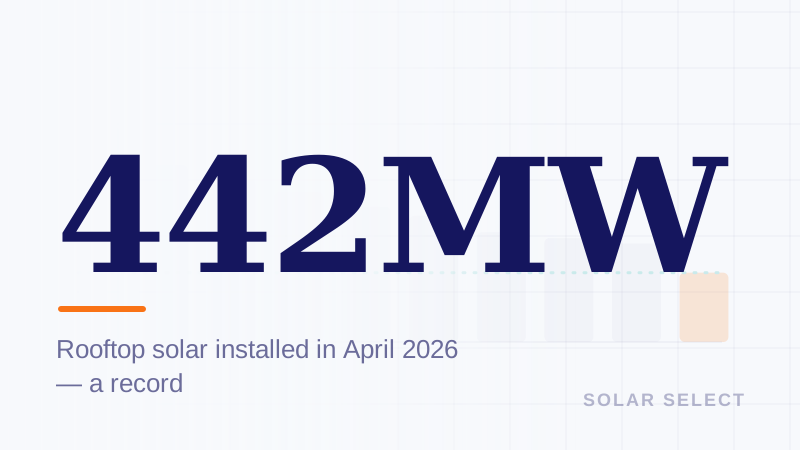
April beat March: 442MW of rooftop solar, nearly double last year
Two record months back to back. The reason is not that more households are going solar — it is that the households going solar are buying bigger systems, because they are buying batteries too.
· 5 min read · Last verified 2026-08-11
The 30-second take
- A record 442MW of small-scale PV capacity was installed across Australia in April 2026.
- That is a 31% increase on the 341MW registered in March, and almost double the 225MW registered in April 2025.
- The $7.2 billion Cheaper Home Batteries Program has supported roughly 300,000 battery installations since launch.
- Increased battery adoption is driving demand for larger solar systems — a bigger battery needs more generation to fill it.
- The practical consequence for buyers is that solar and battery sizing are now one decision, not two.
Two record months in a row
Australia installed a record 442 megawatts of small-scale photovoltaic capacity in April 2026. That followed March’s own record of 341MW, making it a 31% month-on-month increase and almost exactly double the 225MW registered in April 2025.
Doubling year on year in a market as mature as Australian rooftop solar is not normal. Australia has among the highest rooftop solar penetration in the world, and a market that saturated does not usually double.
The explanation is that this is not really a solar story.
Batteries are pulling solar up behind them
The federal Cheaper Home Batteries Program has supported roughly 300,000 battery installations since it launched in July 2025, backed by funding that grew to $7.2 billion.
A battery only earns its keep if it gets charged, and the cheapest way to charge a home battery is with surplus solar. A household putting in a large battery alongside a modest existing array quickly discovers that the array cannot fill it — especially in winter, and especially if they also run an EV.
So the battery decision drags the solar decision with it. New installs are being specified larger, and households with existing systems are expanding them at the same time as they add storage.
“A battery only pays for itself if you can fill it. That is what is pushing array sizes up.”
What this changes about how you should buy
For a long time, solar and battery were two separate purchases made years apart. The standard path was to install panels, live with them, and consider storage later when prices came down.
That sequencing still works, but it is no longer the default, and treating the two as independent decisions now leads to predictable mistakes.
- A battery sized against a small existing array will spend much of the year partially charged, which stretches the payback well beyond what the sales model showed.
- An array sized against current consumption rather than future battery and EV load leaves you paying twice for scaffolding, labour and a second round of paperwork.
- Inverter capacity, switchboard space and export limits all constrain what you can add later. Cheap to plan for, expensive to retrofit.
- If you are adding both, the two rebates run on different schedules — the solar STC deeming period steps down every 1 January, the battery certificate factor every six months.
The part the volume figures do not show
Record installation volumes describe how much equipment went up. They say nothing about how well it went up.
Over the same period the Clean Energy Regulator was inspecting battery installations under the rebate, and found more than 60% of the 1,278 inspected between July 2025 and April 2026 to be substandard, with 1.2% unsafe. The substandard majority is largely labelling and documentation rather than danger — but it is a direct measure of what happens when a market doubles in a year.
A doubling market means every competent crew is booked out and the marginal job is being done by someone with less experience, under more time pressure, than would have been the case two years ago.
That is not an argument against buying now. It is an argument for spending your diligence budget on the installer rather than on comparing panel datasheets.
What this means for you
If you’re a homeowner
- Plan solar and battery as a single system even if you install them in stages. Sizing the array against future storage and EV load costs little now and a lot to retrofit.
- Ask whether your inverter, switchboard and export limit can accommodate what you intend to add later.
- Remember the two rebates step down on different clocks — solar every 1 January, batteries every six months.
- In a market this hot, good crews are booked out. A short lead time can be a warning rather than a convenience.
If you’re an installer
- Quoting the array against future battery and EV load rather than current consumption is both better advice and a larger job.
- Staged plans that document what the customer can add later — and confirm the inverter and switchboard support it — differentiate strongly against single-quote competitors.
- Capacity discipline matters more in a doubling market than in a flat one. The inspection record follows the accreditation, not the invoice.
Read next
Sources
Every quantitative claim on this page traces to one of the sources below — government, regulator, market operator, or independent industry reference.
We use AI to help research and draft. Claims are traced to the sources below and dated. Where we haven’t got a source, we say so on the page — treat that as a starting point and do your own research.
Ready to compare quotes? Postcode in, up to 3 vetted installers out. Free for homeowners, no obligation. All solar news · Solar guides · How it works