Industry
The battery boom is outrunning the people qualified to install it
Install rates went up seven-fold. The pool of accredited battery installers did not. Everything difficult about this market in 2026 traces back to that single mismatch.
· 7 min read · Last verified 2026-08-11
The 30-second take
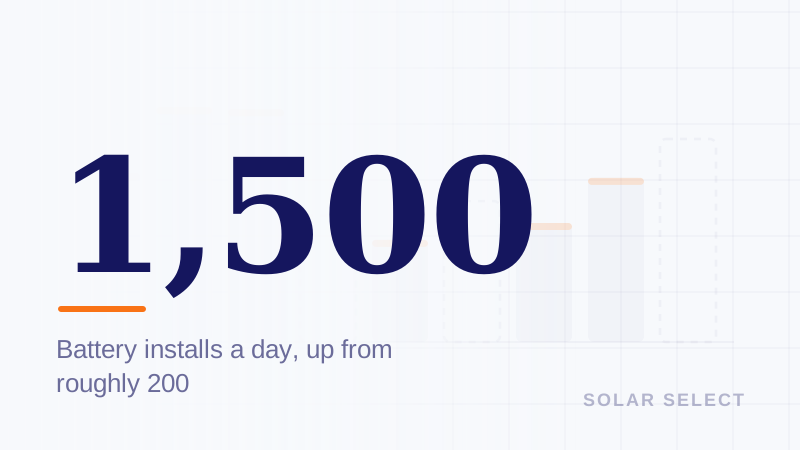
- Battery installations went from roughly 200 a day to more than 1,500 a day after the federal rebate launched.
- The pool of electricians accredited for battery work did not grow proportionally — accreditation takes time that a demand spike does not allow.
- The visible symptoms are longer lead times, rushed installs, and missed rebate deadlines.
- The measurable symptom is inspection data: more than 60% of 1,278 battery installs inspected to April 2026 were classified substandard, with 1.2% unsafe.
- For installers, this is the rare market where capacity discipline is a competitive strategy, not a missed opportunity.
The arithmetic of the bottleneck
Battery work is not solar work with an extra box. It requires an electrician accredited by Solar Accreditation Australia specifically for battery storage, working to AS/NZS 5139 on isolation, ventilation, clearances, labelling and shutdown arrangements.
Accreditation is a process with training, assessment and time in it. You cannot conjure a seven-fold increase in accredited installers inside a year, no matter how strong the demand signal is.
So when the federal rebate pushed daily installs from around 200 to more than 1,500, the additional volume had to be absorbed by the existing workforce doing more jobs per week, by crews entering the category with less battery-specific experience, or by both. In practice it was both.
“You can grow demand seven-fold in a year. You cannot grow an accredited workforce seven-fold in a year.”
What the strain looks like from the outside
Homeowners experience the bottleneck as three separate frustrations without usually recognising them as the same problem.
- Lead times. Good crews are booked weeks or months out, which pushes install dates past rebate step-downs and creates price disputes.
- Rushed finishing. The parts of a job that get compressed under time pressure are the invisible ones: labelling, signage, documentation, handover.
- Inconsistent quality. Two quotes at similar prices can represent very different levels of battery-specific experience, and nothing on the quote reveals which is which.
- Companies entering and exiting. A boom attracts operators who are not equipped for the long run, and the workmanship warranty they write is only as durable as the business behind it.
The Clean Energy Regulator’s inspection programme put a number on the consequence. Across 1,278 battery installations inspected covering July 2025 to April 2026, more than 60% were classified substandard and 1.2% unsafe. Most of the substandard majority are labelling and documentation defects rather than immediate hazards — but they are exactly the failures you would predict from crews working at the edge of their capacity.
Why capacity discipline is a strategy, not a sacrifice
The instinctive response to a demand boom is to take every job. In this specific market, that instinct is expensive.
Inspection outcomes attach to the accreditation of the person who signed off the install, not to the customer or the salesperson. A rectification is a return visit at your cost. A pattern of rectifications is an accreditation problem. And the reputational cost of a bad install now travels further than it used to, because homeowners are actively searching for information about install quality before they buy.
Meanwhile the rebate is stepping down every six months. That means the revenue per job is on a declining path, which makes the cost of a rectification visit a growing proportion of the margin on the original job.
Businesses that hold their throughput to what they can finish properly are trading short-term volume for a durable position in a market where quality is becoming visible for the first time.
The practical playbook
For installers navigating the back half of the boom, the operational moves that matter are unglamorous.
- Quote your real lead time. Optimistic dates near a rebate step-down turn into refund conversations. Honest dates with a written price-protection clause do not.
- Standardise the finish. A pre-departure checklist covering labelling, signage, shutdown documentation and evidence photos closes the highest-frequency failure cluster.
- Brief subcontractors explicitly. A subbie’s missed label is your inspection outcome and your rectification visit.
- Make accreditation visible. Homeowners are now asking whether you are accredited for battery work specifically. Answering that well is a differentiator while most of the market still answers it vaguely.
- Say no to the jobs you cannot do properly. In a market with more demand than capacity, declining work is cheaper than doing it badly.
What homeowners should take from it
The most useful thing a homeowner can understand about this market is that a short lead time is information.
If every well-regarded installer in your area is booked for six weeks and one company can start on Monday, that is worth a question rather than a celebration. There are innocent explanations — a cancellation, a crew freeing up, a business genuinely scaling well. There are also less innocent ones.
The second useful thing is that the workmanship warranty is only as good as the company standing behind it. In a boom, some of the businesses writing 10-year workmanship warranties will not be trading in 10 years. Trading history and accreditation are the closest available proxies for whether the warranty means anything.
What this means for you
If you’re a homeowner
- Treat an unusually short lead time as a question worth asking, not a bonus. In a capacity-constrained market, availability is a signal.
- Ask specifically about Solar Accreditation Australia accreditation for battery work — solar accreditation alone is not the same thing.
- A workmanship warranty is only as durable as the business behind it. Trading history matters more in a boom than in a flat market.
- Build slack into your timing so a rebate deadline never becomes the reason you picked a crew.
If you’re an installer
- Capacity discipline is the strategy. Inspection outcomes follow your accreditation, and rectification visits eat a growing share of a declining per-job margin.
- A standard pre-departure checklist for labelling, signage, documentation and evidence photos closes most of the failure cluster at almost no cost.
- Quote honest lead times with written price protection across rebate step-downs. It prevents the disputes that consume the most time.
- Being able to state your battery-specific accreditation plainly is currently a differentiator, because most of the market answers that question vaguely.
Read next
Sources
Every quantitative claim on this page traces to one of the sources below — government, regulator, market operator, or independent industry reference.
We use AI to help research and draft. Claims are traced to the sources below and dated. Where we haven’t got a source, we say so on the page — treat that as a starting point and do your own research.
Ready to compare quotes? Postcode in, up to 3 vetted installers out. Free for homeowners, no obligation. All solar news · Solar guides · How it works