Safety & standards
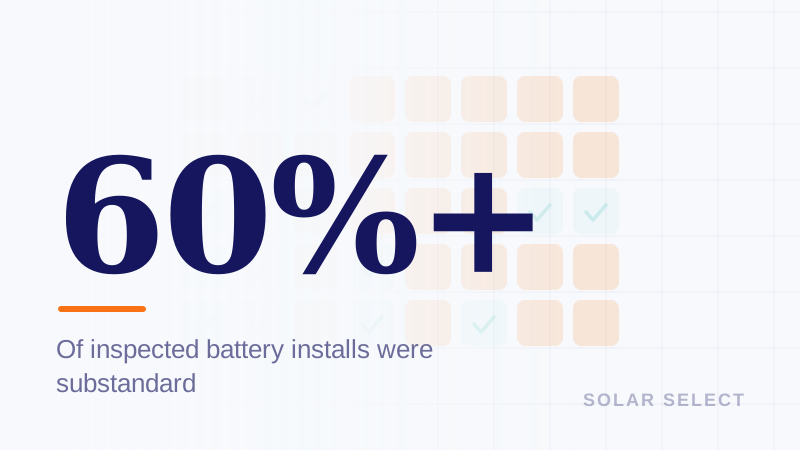
More than 60% of inspected home battery installs were substandard
The Clean Energy Regulator spent the first year of the Cheaper Home Batteries Program inspecting the work. The results are the clearest evidence yet that who installs your battery matters as much as which battery you buy.
· 7 min read · Last verified 2026-08-11
The 30-second take
- Of 1,278 home battery installations inspected between July 2025 and April 2026, the Clean Energy Regulator found more than 60% substandard and 1.2% unsafe.
- Substandard is not the same as dangerous. Most substandard installs keep running safely and need paperwork, labelling or signage rectified. The unsafe minority is the one that needs urgent attention.
- Battery installs went from roughly 200 a day to more than 1,500 a day after the rebate launched. Inspection failures at this rate are a capacity story, not a mystery.
- The rebate is worth chasing. The install is worth checking. Those are two separate decisions and most homeowners only make the first one.
What the Clean Energy Regulator actually found
When the federal Cheaper Home Batteries Program launched on 1 July 2025, it did something no previous Australian solar incentive had done at that scale: it put a large, immediate subsidy behind a product that is meaningfully harder to install than rooftop panels. A battery is a stored-energy device with its own isolation, ventilation, clearance, labelling and shutdown requirements under AS/NZS 5139.
The Clean Energy Regulator inspects a sample of subsidised installations as a condition of the small-scale scheme. Across 1,278 home battery inspections covering installs from July 2025 to April 2026, the regulator classified more than 60% as substandard and 1.2% as unsafe.
Those numbers were reported publicly in April 2026 and they are worth sitting with, because they describe the actual quality distribution of work being done under a national subsidy — not a survey, not sentiment, but inspections of real installations.
“Substandard” and “unsafe” are not the same thing
This is the distinction that most coverage flattens, and flattening it does homeowners no favours in either direction.
A substandard install is one that does not meet the required standard on one or more checklist items. In the large majority of cases the system is still operating and is not presenting an immediate hazard — the defect is something like missing or incorrect labelling, absent shutdown signage, incomplete documentation, or an installation detail that departs from the standard without creating live danger. It needs rectification. It is not a reason to panic.
An unsafe install is a different category. That is the small percentage where an inspector identifies a defect capable of causing real harm, and those are escalated for urgent rectification.
Both categories matter, for different reasons. The unsafe minority matters because someone could get hurt. The substandard majority matters because it tells you what the average job looks like when demand outruns the people qualified to meet it — and because a system that fails an inspection today is a system whose paperwork, warranty position and resale story are all weaker tomorrow.
“Most substandard installs are not dangerous. They are evidence that the work was rushed.”
Why the rebate rush made this predictable
Before the Cheaper Home Batteries Program, Australia was installing home batteries at a rate of roughly 200 a day. Within the program’s first year that rate passed 1,500 a day, and the average battery being installed roughly doubled in size.
That is a seven-fold increase in volume against a workforce that did not grow seven-fold. Battery work requires an electrician with the right accreditation from Solar Accreditation Australia, and accreditation is not something you can add to the labour pool in a quarter.
When a subsidy creates that much demand that fast, three things happen at once: experienced installers book out, less experienced operators enter the category, and every crew in the market feels pressure to compress the time spent per job. Labelling and documentation are the first things to get compressed, because they are the parts of the job the customer never sees.
What actually fails an inspection
The failures skew heavily towards a specific cluster rather than being spread evenly across the whole standard. Labelling and signage items are consistently among the most commonly rectified.
The recurring themes look like this:
- Labelling and signage — missing, incorrect, or non-durable labels on the battery, isolators and switchboard, and absent emergency shutdown procedure signage.
- Documentation — incomplete handover packs, missing commissioning records, or system documentation that does not match what was actually installed.
- Isolation and switching — isolation devices that are not correctly located, identified, or accessible for emergency use.
- Clearances and location — installation positions that do not meet the separation, ventilation or protection requirements for the battery type.
- Mismatch between the claim and the install — what was certified for the rebate not matching the equipment or configuration actually on the wall.
None of those are exotic. They are all things a crew that is not in a hurry gets right as a matter of routine. That is precisely why the failure rate is a useful signal about the installer rather than about batteries as a technology.
How to tell whether your own install was done properly
If you have already had a battery installed under the rebate, you do not need an inspector to do a first-pass sanity check.
- You should have received a handover pack: commissioning records, system documentation, warranty paperwork for both the equipment and the workmanship, and the shutdown procedure. If you never got one, ask for it in writing.
- There should be durable, legible labels on the battery, the isolators and the switchboard — not handwritten stickers, and not missing entirely.
- There should be clearly identified emergency shutdown signage that someone unfamiliar with your system could follow.
- The equipment installed should match the equipment on your paperwork, down to model numbers and capacity.
- The installer should be accredited by Solar Accreditation Australia for battery work specifically, not only for solar.
If something is missing, the first call is to the company that installed it — a reputable business will rectify a labelling or documentation defect without argument, because it costs them a service visit and protects their accreditation. If that company no longer exists, the defect becomes yours to fix at your own cost, which is its own argument for looking closely at who you hire in the first place.
The part that is actually in your control
You cannot control the size of the rebate, the pace of the boom, or how many crews are working beyond their comfortable capacity this quarter. You can control which of those crews ends up on your roof.
The inspection data does not say batteries are a bad idea. Home storage is doing exactly what it was supposed to do for the households that have it. What the data says is that quality is unevenly distributed across the installer market right now, and that the difference between a good outcome and a rectification notice is almost entirely a function of who did the work.
That is the same conclusion from the other direction that a good installer would give you: the hardware is largely commoditised, and the variable is workmanship.
“The rebate saves you money. The wrong installer can give it back.”
What this means for you
If you’re a homeowner
- Ask any installer quoting you for a battery whether they hold Solar Accreditation Australia accreditation for battery work, not just solar. It is a fair question and a good business will answer it in one sentence.
- Treat the handover pack as part of what you are buying. Agree in writing that documentation, labelling and shutdown signage are included before you sign.
- Do not let rebate deadlines push you into the first available crew. A rebate step-down costs you a few hundred dollars; a rectification you pay for yourself can cost more, and an orphaned warranty can cost more again.
- If you already have a battery and never received documentation, request it now while the installing company still exists.
If you’re an installer
- Labelling, signage and documentation are the highest-frequency failure cluster and the cheapest to get right. A standard pre-departure checklist closes most of the exposure.
- Inspection outcomes attach to your accreditation, not to the customer. The compliance cost of a rushed job lands on your business twice — once in the rectification visit, once in the record.
- Quality is becoming a visible differentiator in this category for the first time. Homeowners are now reading about inspection failure rates before they get quotes, and answering the accreditation question well is a sales advantage.
Read next
Sources
Every quantitative claim on this page traces to one of the sources below — government, regulator, market operator, or independent industry reference.
We use AI to help research and draft. Claims are traced to the sources below and dated. Where we haven’t got a source, we say so on the page — treat that as a starting point and do your own research.
Ready to compare quotes? Postcode in, up to 3 vetted installers out. Free for homeowners, no obligation. All solar news · Solar guides · How it works