Policy & rebates
The battery rebate changed on 1 May. Here is what it is worth now.
Two changes landed at once: the rebate steps down twice as often, and it now tapers by battery size. Neither ends the scheme, but both change the maths on how big a system you should buy.
· 8 min read · Last verified 2026-08-11
The 30-second take
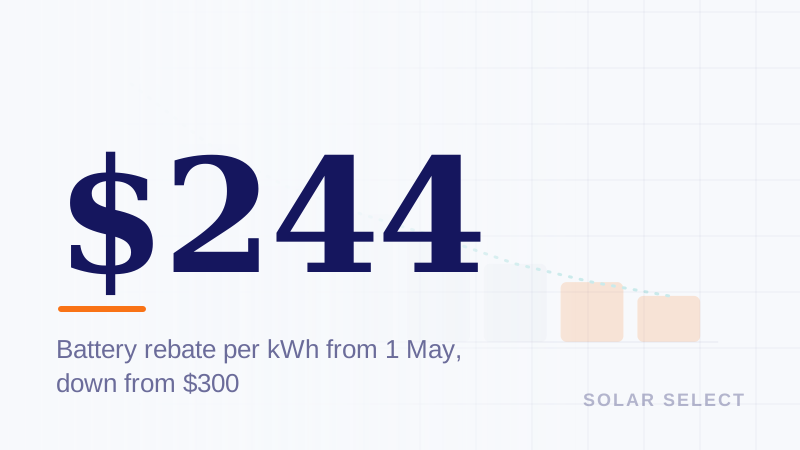
- The per-kWh rebate fell from roughly $300/kWh to about $244/kWh from 1 May 2026.
- Step-downs now happen every six months instead of annually, running through to the program’s end on 31 December 2030.
- Support now tapers by battery size — typical household capacity keeps full support, and larger systems get sharply reduced support per kWh above the thresholds.
- The rebate is locked in on your installation date, not your quote date or deposit date. That single fact is where most of the disappointment in this category comes from.
- A smaller, well-installed battery now often beats a bigger one bought in a hurry — the tapering removes much of the reason to oversize.
What actually changed
The Cheaper Home Batteries Program launched on 1 July 2025 and did exactly what it was designed to do, with more force than anyone budgeted for. Home battery installs went from roughly 200 a day to more than 1,500 a day, and the average battery size Australians were buying roughly doubled.
From 1 May 2026, the way the rebate is calculated changed in two ways at once.
- The decline got faster. The rebate now steps down every six months rather than annually, on a schedule that runs to the end of 2030.
- The rebate now tapers by size. Instead of a flat rate per kWh across any capacity, the certificate factor is banded — common household sizes keep full support, and capacity above the thresholds attracts sharply reduced support per kWh.
In headline terms, the rebate moved from around $300 per kWh of usable capacity to roughly $244 per kWh. On a typical mid-sized household battery that is a difference of several hundred to a couple of thousand dollars depending on the system, which is real money — but it is not the scheme ending, and it is not a reason to make a rushed decision.
Why the government changed it
The program was originally costed at about $2.3 billion. Demand pushed the forecast to roughly $7.2 billion over four years.
That overshoot came from two directions. More households took it up than expected, and the households taking it up bought bigger batteries than expected — because when the subsidy is a flat rate per kWh, every extra kWh you add attracts the same discount, so there is no financial brake on oversizing.
The tapering fixes that specific incentive. It keeps the subsidy pointed at the household-scale storage the scheme was meant to encourage, and stops the budget being absorbed by very large systems that a small number of households can install. Whether you think that is fair depends on how big a battery you wanted, but the design logic is coherent.
“A flat per-kWh subsidy pays you to oversize. The tapering removes that incentive on purpose.”
The date that decides your rebate is the install date
This is the single most expensive misunderstanding in the category, and it is worth being blunt about it.
The certificate factor that determines your rebate is locked in on the date your system is installed. Not the date you got the quote. Not the date you paid a deposit. Not the date the contract was signed.
That matters enormously in a market where the workforce is stretched and lead times can run weeks or months. A quote written under one rebate rate and installed after a step-down is a quote whose numbers no longer hold, and the gap lands on you unless your contract explicitly says otherwise.
Before you sign anything near a step-down date, get two things in writing: the expected installation date, and what happens to the price if the install slips past a rebate change. A good installer will have a clear answer to both because they have already had this conversation with other customers. An installer who waves it away is telling you something.
Does the tapering change what size battery you should buy?
For most households, less than you would think — because the right battery size was never really a subsidy question in the first place.
The size that makes sense for you is driven by your evening consumption, how much surplus solar you actually export, whether you want backup during outages, and whether you plan to join a virtual power plant. A battery sized to those realities will usually sit inside the bands that keep full support anyway.
What the tapering does change is the calculus for households that were being talked into a very large system on the logic that "the rebate scales with it". That argument is now substantially weaker. If someone is still using it, ask them to show you the numbers under the current banding rather than the old flat rate.
- Size to your evening and overnight load, not to your roof or your rebate.
- If backup during outages matters to you, say so early — it changes the equipment and the wiring, not just the capacity.
- If you intend to join a virtual power plant, check the minimum and maximum capacity the program you want actually accepts before you fix the size.
- Ask for the quote to show the rebate as a separate line item with the certificate factor used, so you can see what happens if the install date moves.
The risk that grew faster than the rebate shrank
There is a second story running underneath the rebate change, and it is the one that will cost more households more money.
In the same period the program was driving install volumes up seven-fold, the Clean Energy Regulator was inspecting the work. Across 1,278 inspections of installs from July 2025 to April 2026, more than 60% were found to be substandard and 1.2% unsafe. Most substandard installs are not dangerous — they are labelling, signage and documentation defects that need rectification — but they are a direct measure of what happens when demand outruns installer capacity.
So the honest framing of the 1 May change is this: the subsidy got smaller and the quality risk did not. A few hundred dollars of rebate is a smaller number than the cost of rectifying a bad install, and a much smaller number than the cost of a workmanship warranty you cannot claim on because the company that wrote it no longer trades.
“Before you claim the battery rebate, check who’s installing it.”
What to do if you are buying in the next few months
The scheme runs to 31 December 2030 and steps down every six months. There is no cliff edge, and there is no version of this where waiting indefinitely is rewarded — the rebate only goes down from here. But there is also no version where rushing into the first available crew is rewarded either.
The practical middle path: decide on the right system for your household, get quotes that show the rebate transparently, choose the installer on the strength of their accreditation and their answers rather than the bottom line, and then let the install date fall where it falls with the price protection written into the contract.
What this means for you
If you’re a homeowner
- Check that every quote states the certificate factor and the assumed installation date. If those are missing, the rebate figure in the quote is an estimate, not a number you can rely on.
- Ask what happens to your price if the install slips past the next six-monthly step-down, and get the answer in writing.
- Be sceptical of any pitch that leans on "buy bigger because the rebate scales". Under the banded factors, it largely no longer does.
- The money you save by picking a cheaper crew is smaller than the money a rectification or an unclaimable workmanship warranty can cost you.
If you’re an installer
- Quotes that show the certificate factor and a date-based price protection clause convert better in a stepping-down market, because they remove the customer’s biggest unspoken fear.
- The tapering ends the easy upsell to oversized systems. The replacement pitch is correct sizing plus demonstrable install quality — which is a better long-term position anyway.
- Lead times are now a pricing input, not just a scheduling problem. Booking a job past a step-down without addressing it in the contract is a dispute waiting to happen.
Read next
Sources
Every quantitative claim on this page traces to one of the sources below — government, regulator, market operator, or independent industry reference.
We use AI to help research and draft. Claims are traced to the sources below and dated. Where we haven’t got a source, we say so on the page — treat that as a starting point and do your own research.
Ready to compare quotes? Postcode in, up to 3 vetted installers out. Free for homeowners, no obligation. All solar news · Solar guides · How it works