Policy & rebates
Everything that changed for solar households on 1 July
Bills down in most regions, feed-in tariffs down again, a tighter income cap in Victoria, and new money in New South Wales. Here is the whole list in one place.
· 8 min read · Last verified 2026-08-11
The 30-second take
- Default Market Offer prices fell for most households from 1 July — roughly 3–7% down in NSW and south-east Queensland, and up about 1.4% in South Australia.
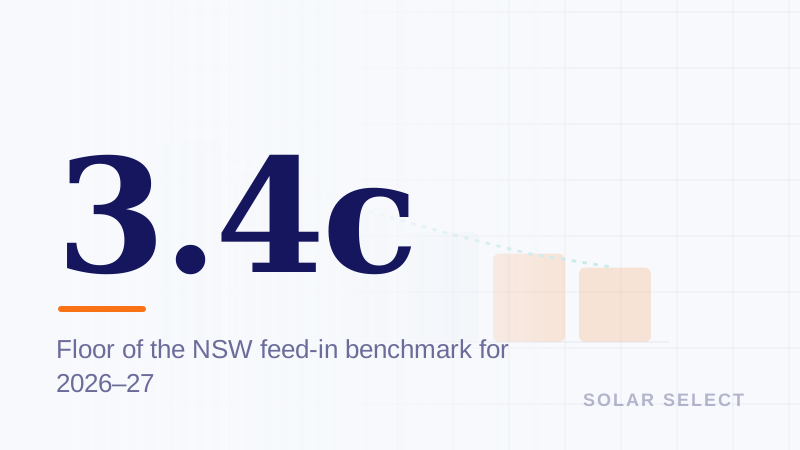
- NSW feed-in tariffs fell again. IPART’s benchmark range dropped to 3.4–6.5c/kWh for 2026–27, from 4.8–7.3c the previous year.
- Victoria tightened the Solar Homes income cap to $150,000. The $1,400 Solar Homes solar rebate continues.
- NSW launched a Home Energy Saver Program with zero-interest loans of up to $15,000, and expanded its VPP incentive to batteries up to 50kWh.
- The pattern across all of it: less reward for exporting, more support for storing and shifting.
Electricity prices: down for most, up in South Australia
The Australian Energy Regulator’s final Default Market Offer for 2026–27 took effect on 1 July. The DMO is the benchmark price cap for standing offers in New South Wales, south-east Queensland and South Australia, and it sets the reference point most market offers are advertised against.
Residential flat-rate prices fell in the order of 3% to 7% in New South Wales and south-east Queensland, and rose by around 1.4% in South Australia.
The AER attributed the reductions to three drivers: lower wholesale electricity costs, reduced environmental scheme costs, and lower retail operating costs. The first of those is largely a renewables story — abundant solar and wind have pushed wholesale prices down substantially.
The DMO also introduced comparison prices for time-of-use tariffs for the first time, which makes it easier to compare plans where the rate changes across peak, shoulder and off-peak periods. For solar households, that comparison is more useful than the flat-rate one, because a time-of-use plan interacts directly with when your system generates.
Feed-in tariffs fell again
IPART’s benchmark range for New South Wales solar feed-in tariffs dropped to 3.4 to 6.5 cents per kilowatt-hour for 2026–27, down from 4.8 to 7.3 cents the previous year. Retailer buyback rates followed, with several moving down from around 4 cents to 3 cents.
This continues a multi-year trend and it is not a conspiracy against solar owners. Feed-in tariffs reflect the wholesale value of the energy you export, and midday energy in a grid with this much rooftop solar is genuinely abundant. Abundant energy is cheap energy.
The practical implication is the one that has been building for several years: the value of a rooftop system now comes overwhelmingly from self-consumption — the grid electricity you avoid buying — rather than from export income. Any savings projection built mainly on export revenue is describing a market that no longer exists.
“A falling feed-in tariff is not a punishment. It is the market telling you midday power is no longer scarce.”
Victoria: tighter eligibility, same rebate
The most significant confirmed state change on 1 July was in Victoria, where the Solar Homes income cap tightened to $150,000 in combined household income.
Victoria continues to run its $1,400 Solar Homes solar rebate. The change is to who qualifies, not to what qualifying is worth.
If you are in Victoria and were counting on Solar Homes, check the current threshold against your household income before you build it into a budget. Eligibility criteria in this scheme have moved more than once.
New South Wales: new loans, bigger VPP incentive
New South Wales moved in the opposite direction, adding support rather than narrowing it.
- The Home Energy Saver Program launched with zero-interest loans of up to $15,000 — useful for households where the barrier is upfront capital rather than the total cost.
- The NSW Virtual Power Plant incentive expanded to batteries up to 50kWh from 1 July 2026, widening the range of systems that can attract the state incentive for joining a VPP.
The VPP expansion is notable because it sits alongside the federal rebate’s new size tapering. The federal scheme now reduces per-kilowatt-hour support above certain capacity bands, while the NSW VPP incentive extends up to 50kWh. Households in NSW considering a larger battery should model both together rather than assuming they point the same way.
What the whole package actually signals
Read together, the 1 July changes are consistent, and the consistency is the point.
Exporting solar to the grid at midday is worth less than it was. Storing that energy and using or exporting it in the evening is worth more, and is supported by both federal and state money. Shifting your consumption into daylight hours is worth more than it was. And the whole system is being nudged towards households that can respond to time signals rather than generate indiscriminately.
If you already have solar and no battery, the highest-value response costs nothing: move discretionary load — dishwasher, laundry, pool pump, hot water, EV charging — into the middle of the day, and check whether a time-of-use plan suits your pattern better than a flat rate.
If you are buying now, the changes reinforce that the system should be designed around your consumption profile, not around an export revenue line.
One thing that did not change
None of these adjustments touch the risk that has cost Australian households the most money over the past year: install quality.
The Clean Energy Regulator’s battery inspection data through the first year of the federal rebate found roughly 62% of inspected installations substandard, with a small fraction unsafe. A tighter income cap or a three-cent feed-in tariff is a rounding error next to a rectification you pay for yourself, or a workmanship warranty written by a company that no longer trades.
The rebates and tariffs are worth understanding. The installer is worth choosing carefully.
“The rebate saves you money. The wrong installer can give it back.”
What this means for you
If you’re a homeowner
- Check whether a time-of-use plan now suits you better than a flat rate — the DMO published comparison prices for them for the first time this year.
- Stop valuing solar on export income. Self-consumption and load shifting carry the return now.
- Victorians should re-check Solar Homes eligibility against the $150,000 cap before budgeting for the rebate.
- NSW households short on upfront capital should look at the Home Energy Saver zero-interest loans before assuming a system is unaffordable.
If you’re an installer
- Savings models still built on export revenue will not survive customer scrutiny at 3c/kWh. Rebuild them around self-consumption.
- The NSW VPP incentive extending to 50kWh while the federal factor tapers above certain bands is a genuinely complex interaction. Modelling both correctly is a differentiator.
- State eligibility rules moved again this year. Quoting a state rebate the customer turns out not to qualify for is an avoidable trust failure.
Read next
Sources
Every quantitative claim on this page traces to one of the sources below — government, regulator, market operator, or independent industry reference.
We use AI to help research and draft. Claims are traced to the sources below and dated. Where we haven’t got a source, we say so on the page — treat that as a starting point and do your own research.
Ready to compare quotes? Postcode in, up to 3 vetted installers out. Free for homeowners, no obligation. All solar news · Solar guides · How it works