Technology
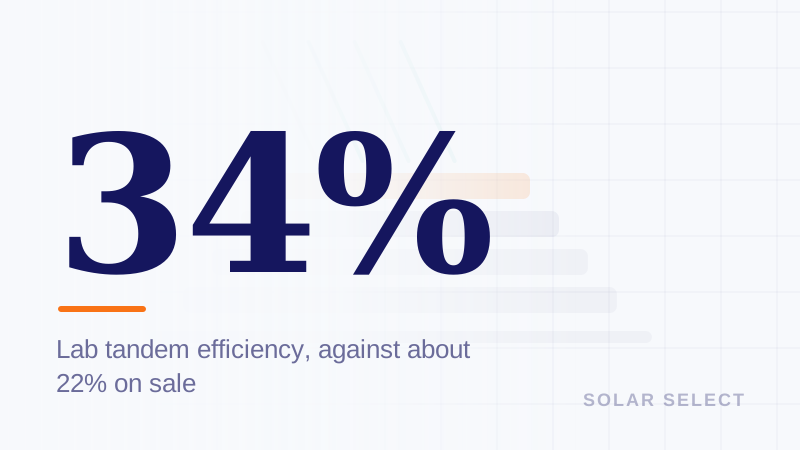
Lab cells are hitting 34%. Your roof will get about 22%. That is fine.
Perovskite tandem cells keep breaking efficiency records, and a new one landed in July. The gap between a laboratory record and a panel you can actually buy is where most solar marketing goes wrong.
· 6 min read · Last verified 2026-08-11
The 30-second take
- Researchers at Helmholtz-Zentrum Berlin and Humboldt-Universität set a world record for a perovskite-CIGS tandem cell at 25.5%, independently confirmed by the European Solar Test Installation.
- The broader perovskite-silicon tandem record sits near 35% on a small cell, with around 33% demonstrated on a larger area.
- The panels you can actually buy in Australia are around 22% efficient.
- The gap is not marketing. It is the distance between a 1cm² laboratory cell and a weatherproof module warranted for 25 years.
- For a household buying now, panel efficiency is rarely the constraint — roof area, shading, inverter sizing and installation quality matter far more.
What was actually achieved
In July 2026, researchers from Germany’s Helmholtz-Zentrum Berlin and Humboldt-Universität zu Berlin announced a world-record power conversion efficiency of 25.5% for a perovskite-CIGS tandem solar cell, confirmed by the European Solar Test Installation.
That sits within a broader run of tandem records. Perovskite-silicon tandem cells — the combination closest to commercial relevance — have reached around 35% on small devices, with roughly 33% demonstrated on substantially larger cell areas. Commercial tandem modules have begun shipping in small volumes to utility customers overseas.
These are genuine advances. Conventional single-junction silicon is approaching a hard physical ceiling, and stacking a perovskite layer on top of silicon is the most credible route past it — the two materials capture different parts of the solar spectrum, so the stack collects more of the available light than either alone.
Why a record cell is not a panel
Every efficiency record needs three questions asked of it before it means anything to a homeowner: how big was it, how long did it last, and can it be manufactured?
Records are typically set on very small cells — often around one square centimetre. Efficiency reliably drops as area increases, which is why the same technology reports a lower number at large-cell scale and a lower number again as a full module. A module also loses a few percentage points to the gaps between cells, the glass, the encapsulation and the wiring.
Durability is the harder problem. A rooftop panel in Australia has to survive 25 years of UV, heat cycling, humidity and hail while degrading only slightly. Perovskites have historically been more sensitive to moisture and heat than silicon, and solving that without giving back the efficiency gain is the central engineering challenge.
Then there is manufacturing. Silicon PV benefits from decades of accumulated production scale, which is the reason it is cheap. A new technology entering that market competes not with silicon’s efficiency but with silicon’s cost per watt — and early commercial tandem products cost more than the incumbent, not less.
“A record cell is one square centimetre in a lab. A panel is two square metres on your roof for 25 years.”
Does panel efficiency even matter for your house?
Less than the marketing implies, and this is worth being concrete about.
Efficiency determines how many watts you get per square metre. It matters when roof space is the binding constraint — a small or awkward roof where you cannot fit the capacity you want. In that situation, paying more per watt for higher-efficiency panels is a rational trade.
For most Australian homes, roof space is not the binding constraint. There is more north-facing roof than the household needs, and the real limits are budget, inverter sizing, network export limits and shading. In that situation, higher-efficiency panels buy you a smaller array for the same output at a higher price — which is not obviously a win.
- Constrained roof? Efficiency is worth paying for.
- Plenty of roof? Cost per watt matters more than watts per square metre.
- Shading? Panel-level electronics or microinverters will do more for your output than a couple of efficiency points.
- Export-limited? Extra generation capacity you cannot export or use has little value.
The honest advice on waiting
The pattern with solar technology is remarkably consistent: laboratory records precede mainstream availability by years, and the first commercial products are more expensive rather than cheaper.
Someone who decided in 2016 to wait for the next generation of panels spent a decade buying grid electricity while the technology they were waiting for arrived, got cheap, and was itself superseded. The compounding cost of waiting almost always exceeds the benefit of the improvement.
The efficient position for a household is to buy proven equipment from an established manufacturer now, let the next generation mature on someone else’s roof, and put the attention you would have spent comparing datasheets into choosing who installs it.
That last point is not a platitude. Across national inspection data in Australia, the variation in outcomes attributable to installation quality dwarfs the variation between reputable panel brands. A 22%-efficient panel installed properly will outperform a 24%-efficient panel installed badly for the entire life of the system.
What to watch for
Tandem technology will reach residential rooftops. The signals worth watching are not efficiency records but commercial ones: full-size modules with standard 25-year performance warranties, from manufacturers with the balance sheet to honour them, at a cost per watt competitive with silicon.
When those three things line up, the technology has arrived. Until then, an efficiency headline is a research result, not a purchasing signal.
What this means for you
If you’re a homeowner
- Do not delay a purchase waiting for tandem panels. Early commercial products are more expensive, not cheaper, and the wait costs you bill savings every quarter.
- Panel efficiency matters most when roof space is your constraint. If you have plenty of roof, cost per watt is the better metric.
- A well-installed conventional panel beats a high-efficiency panel installed badly, every year, for 25 years.
- Judge new technology on warranty terms and manufacturer durability, not on laboratory records.
If you’re an installer
- Customers arrive with efficiency-record headlines. Explaining the cell-to-module gap clearly is a fast credibility win.
- Efficiency-led selling only holds up on roof-constrained jobs. On open roofs it invites a price comparison you will lose.
- Redirecting the conversation from panel specifications to sizing, shading strategy and install quality moves it onto ground where a quality business actually competes.
Read next
Sources
Every quantitative claim on this page traces to one of the sources below — government, regulator, market operator, or independent industry reference.
We use AI to help research and draft. Claims are traced to the sources below and dated. Where we haven’t got a source, we say so on the page — treat that as a starting point and do your own research.
Ready to compare quotes? Postcode in, up to 3 vetted installers out. Free for homeowners, no obligation. All solar news · Solar guides · How it works