Market data
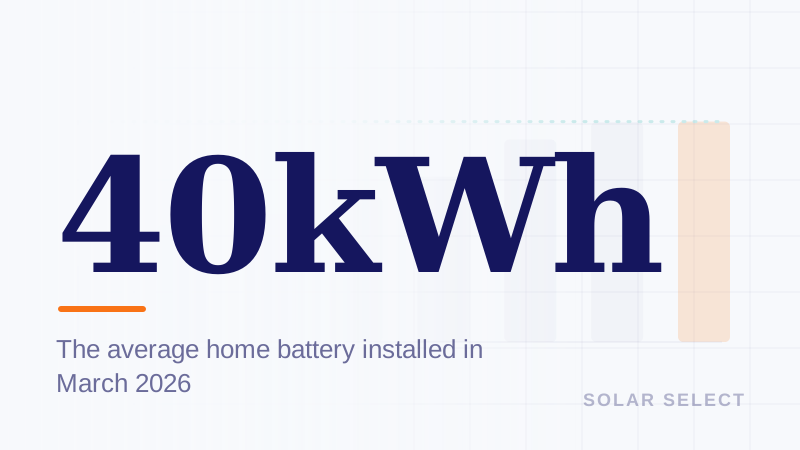
Record March — and the average home battery is now around 40kWh
Rooftop solar installations hit a new monthly high and battery capacity jumped 35%. The more interesting number is the size of the batteries Australians are buying.
· 6 min read · Last verified 2026-08-11
The 30-second take
- Australia registered 341MW of small-scale solar capacity in March 2026, a 19% monthly increase, with battery capacity up 35%.
- The average battery size reached about 40kWh, with many systems clustered in the 40–50kWh range.
- For context, a typical Australian household uses somewhere around 10–20kWh across a whole day, and far less than that overnight.
- The flat per-kWh rebate in force at the time paid the same subsidy rate on every extra kilowatt-hour, which removed the financial brake on oversizing.
- Bigger is not automatically better. A battery you never fully cycle is capital that never earns its keep.
The headline numbers
March 2026 was a record month for Australian rooftop solar. The country registered 341 megawatts of small-scale photovoltaic capacity, a 19% increase on the previous month, while battery capacity registrations jumped 35%.
Both records were driven by the same thing: the federal Cheaper Home Batteries Program, which had by then been running for around eight months and had fundamentally changed the economics of home storage.
What makes the March data more interesting than a simple growth story is the composition. Average battery size hit roughly 40kWh, with a large share of systems clustered between 40kWh and 50kWh.
Why 40kWh is a striking number
A typical Australian household consumes somewhere in the range of 10 to 20 kilowatt-hours across an entire day, and only a portion of that after the sun goes down. Overnight load for most homes — lights, fridge, standby, some cooking and entertainment — is a fraction of the daily total.
Against that, a 40kWh battery is a very large device. For a household with high evening consumption, an electric vehicle charging at home, ducted air conditioning running through summer nights, or a genuine desire for multi-day backup, it can make sense. For a typical family home, it is substantially more storage than the daily cycle can use.
That matters because a battery earns its return by cycling. Capacity that never gets charged and discharged is capital sitting on a wall.
“A battery earns its return by cycling. Capacity you never use is just an expensive wall fixture.”
The subsidy design that encouraged it
The oversizing was not irrational on the buyer’s part. It was the predictable result of how the rebate was structured at the time.
Through the program’s first year, the subsidy was effectively a flat rate per kilowatt-hour of usable capacity. Every additional kilowatt-hour you added attracted the same discount rate as the first one. That means the marginal cost of upsizing was lower than it would otherwise be — and a salesperson could truthfully say that a bigger battery attracted a bigger rebate.
What that structure did not do was ask whether the extra capacity would ever be used. Combined with a sales environment where bigger systems mean bigger invoices, the direction of travel was always going to be up.
This is precisely the behaviour the government moved to correct from 1 May 2026, when the certificate factor began tapering across capacity bands — keeping full support for common household sizes and sharply reducing support for capacity above the thresholds.
How to size a battery properly
The honest method is unglamorous and takes about ten minutes with a recent bill or your smart meter data.
- Work out your actual evening and overnight consumption, not your daily total. That is the load a battery is displacing.
- Check how much surplus solar you genuinely export on a typical day. You cannot store energy you do not generate.
- Decide whether backup during outages matters, and for which circuits. This affects equipment and wiring more than it affects capacity.
- If you plan to join a virtual power plant, check the capacity range that program actually accepts before fixing a size.
- If you are adding an EV in the next few years, model that separately — it is the one change that genuinely justifies a much larger system.
A battery sized to those realities will usually land well inside the bands that still attract full rebate support, which means correct sizing and maximum subsidy efficiency now point in the same direction.
The quality question underneath the volume
Record install volumes are good news for the energy transition and a warning sign for individual buyers.
Battery installations went from roughly 200 a day before the rebate to more than 1,500 a day during this period. The pool of electricians accredited for battery work did not grow at anything like that rate. Something has to give, and what gives is time per job.
The Clean Energy Regulator’s inspection results from this period bear that out: of 1,278 battery installations inspected covering July 2025 to April 2026, more than 60% were classified substandard, with 1.2% unsafe. Most substandard installs are labelling and documentation defects rather than dangers, but they are a direct measurement of what a boom does to workmanship.
So the two lessons from a record month point the same way. Buy the size you will actually use, and spend more of your attention on who installs it than on how many kilowatt-hours are on the invoice.
What this means for you
If you’re a homeowner
- Size the battery to your evening and overnight consumption, not to your roof, your rebate, or what a neighbour bought.
- If a quote recommends 40kWh or more, ask to see the consumption data that justifies it. There are good reasons for a large battery, but they should be visible in your usage.
- Under the post-May banded rebate, oversizing no longer attracts proportional subsidy — so the main argument for it has largely gone.
- Record volumes mean stretched crews. In a boom, the installer is the variable that most affects your outcome.
If you’re an installer
- The banded certificate factor ends capacity-led selling. Sizing justified by real consumption data is the replacement, and it holds up better under comparison.
- Customers are increasingly arriving having read about install quality. Being able to talk about accreditation and handover documentation is now part of the sale.
- Volume records are a capacity warning. Taking on more jobs than you can finish properly shows up in inspection outcomes attached to your accreditation.
Read next
Sources
Every quantitative claim on this page traces to one of the sources below — government, regulator, market operator, or independent industry reference.
We use AI to help research and draft. Claims are traced to the sources below and dated. Where we haven’t got a source, we say so on the page — treat that as a starting point and do your own research.
Ready to compare quotes? Postcode in, up to 3 vetted installers out. Free for homeowners, no obligation. All solar news · Solar guides · How it works