Technology
V2G works. The paperwork is what’s holding it back.
Australia’s first industry-wide vehicle-to-grid roundtable put carmakers, charger makers, retailers and regulators in one room. They agreed the technology is proven — and that almost everything around it isn’t aligned yet.
· 7 min read · Last verified 2026-08-11
The 30-second take
- The Vehicle-Grid Network held its first industry roundtable in February 2026, with 51 stakeholders from 31 organisations — carmakers, charger manufacturers, energy retailers, regulators, state governments and researchers.
- The consensus: V2G technology works. What is missing is aligned standards, safety frameworks, certification pathways, market rules and consumer protections.
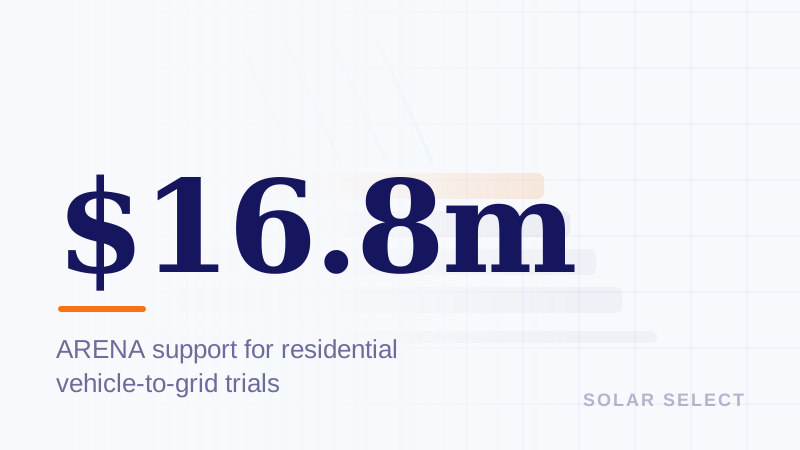
- ARENA committed a further $13.6 million to expand a residential V2G trial led by Amber Electric, taking its total support to $16.8 million.
- That expansion lifts V2G households in the trial from 50 to 1,000, with smart-charging participation growing from 950 homes to 2,000.
- For homeowners, the practical read is: your next EV may well be V2G-capable before your network, retailer and charger approvals catch up.
What the roundtable was actually for
Vehicle-to-grid — using an electric car’s battery to power your house or export to the grid — has been "two years away" in Australia for several years running. In February 2026 the Vehicle-Grid Network convened the first industry-wide roundtable to work out precisely what the holdup is.
Fifty-one stakeholders from 31 organisations attended: vehicle manufacturers, charger makers, energy companies, regulators, state government representatives and research bodies. That breadth matters, because the answer they landed on is one that no single participant could have fixed alone.
The finding was that the technology is not the constraint. Bidirectional chargers exist, capable vehicles are on sale, and trials have demonstrated the grid benefits. What is not in place is the connective tissue: consistent standards, a clear safety framework, a certification pathway that manufacturers can actually navigate, market rules that let the exported energy be valued properly, and consumer protections for households putting a car battery to work.
“Everyone agreed V2G works. Nobody could point to a single rulebook that says how.”
The money is moving anyway
Alongside the coordination work, the funding picture improved materially.
The Australian Renewable Energy Agency committed an additional $13.6 million to scale up a residential V2G trial led by Amber Electric, lifting ARENA’s total support for the program to $16.8 million.
The expansion is significant in scale rather than just budget:
- Households with V2G capability grow from 50 to 1,000 within the trial.
- Smart charging participation expands from 950 homes to 2,000.
- Amber has signalled a commercial V2G product following the trial expansion.
- Major retailers including AGL and Origin have flagged their own pilots, with Origin planning a trial with an initial group of customers.
Networks are moving too, if unevenly. The ACT distribution network has approved V2G export for compliant charger installations, with participants required to use an approved installer and a compliant charger. South Australia has run aggregated V2G trials demonstrating grid stability benefits, with commercial expansion signalled for 2026–27.
Why "the rules aren’t aligned" is a bigger problem than it sounds
When an industry says the technology works but the frameworks are not aligned, it can sound like bureaucratic hand-wringing. In this case it is not.
A V2G installation sits at the intersection of four regulatory worlds that were built separately: automotive standards, electrical installation standards, distribution network connection rules, and energy market participation rules. Each has its own certification process, its own responsible body, and its own timeline.
The practical consequence for a household is that a car and a charger can both be technically capable of V2G, and the installation can still be impossible — because the specific charger is not on the specific network’s approved list, or because there is no clear pathway to certify the combination, or because the retailer has no tariff that values the export.
This is also why V2G availability varies so sharply by state and by network. It is not that some networks are more enthusiastic; it is that some have completed an approval process that others have not started.
What this means if you are buying now
If you are weighing an EV, a home battery, or both, the honest position in early 2026 is that V2G is a real capability worth planning for and a poor thing to depend on.
Plan for it in the sense of not closing doors: leave switchboard capacity, ask about bidirectional-ready wiring while an electrician is already on site, and check whether the vehicle you are buying supports the bidirectional standard your market is converging on.
Do not depend on it in the sense of substituting a hypothetical V2G setup for a home battery you actually need now. A battery you can install and use this year is worth more than a capability that requires your network, your retailer, your charger vendor and your carmaker to all line up.
- Check whether your distribution network currently approves V2G export at all — this varies by state and by network, not by brand.
- Ask whether the specific charger model is approved by that network, not just whether it is sold in Australia.
- Confirm the installer is approved by the network for this work where that requirement exists.
- Check whether your retailer has a tariff that actually pays for exported energy from a vehicle, rather than treating it as ordinary solar export.
The installer angle
For installers, V2G is the clearest example yet of a category where the differentiator is knowledge rather than price.
A homeowner asking about V2G in 2026 is asking a question that cannot be answered with a product catalogue. It requires knowing the local network’s current position, the approved equipment list, the certification state of the charger, and what the retailer will actually pay. That is exactly the kind of question a rushed, price-led operator gets wrong and a well-run business gets right.
It is also a good early filter for homeowners. If you ask an installer about V2G and get a confident yes with no caveats, they are probably not close enough to the detail. The correct answer in most of Australia right now includes the words "depends on your network".
What this means for you
If you’re a homeowner
- V2G is coming but is not a substitute for a home battery today. Buy the storage you need now; leave headroom for the vehicle later.
- Availability is decided by your distribution network and your retailer, not by the car brand. Check both before assuming a setup is possible.
- If an electrician is already doing work at your switchboard, ask what it would cost to leave the install bidirectional-ready. Doing it later costs more.
- Treat a no-caveats "yes we can do V2G" as a prompt for more questions, not a reassurance.
If you’re an installer
- Network approval lists and certification status change by jurisdiction and by quarter. Knowing your local position is a genuine competitive advantage right now.
- V2G enquiries are high-intent and usually come from customers who also want solar and storage. Handling the question well converts the broader job.
- Being explicit about what is not yet possible builds more trust in this category than promising capability that depends on someone else’s approval process.
Read next
Sources
Every quantitative claim on this page traces to one of the sources below — government, regulator, market operator, or independent industry reference.
We use AI to help research and draft. Claims are traced to the sources below and dated. Where we haven’t got a source, we say so on the page — treat that as a starting point and do your own research.
Ready to compare quotes? Postcode in, up to 3 vetted installers out. Free for homeowners, no obligation. All solar news · Solar guides · How it works