Technology
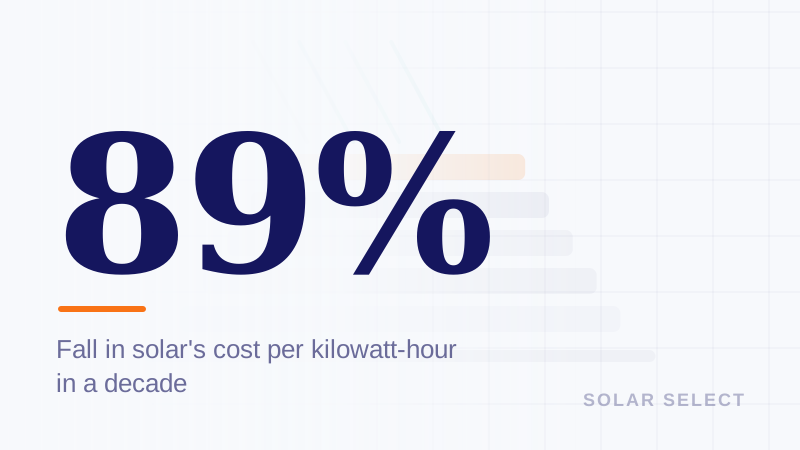
Solar got 89% cheaper in a decade. Batteries are on the same curve.
The global manufacturing story behind falling prices is the strongest argument for buying — and the most common excuse for waiting. Both readings cannot be right.
· 6 min read · Last verified 2026-08-11
The 30-second take
- The International Energy Agency describes solar as the cheapest source of electricity in history, with cost per kilowatt-hour down roughly 89% over a decade.
- Solar PV is on track to become the single largest source of electricity generation globally by the early 2030s, with installed capacity forecast to exceed 5,000GW by 2030.
- Battery cell costs are following the same learning curve — falling as cumulative manufacturing volume grows, not as a function of time.
- Storage is widely expected to reach economic parity across most markets by around 2027.
- That is an argument for buying the right system properly, not for waiting. Waiting has a running cost most people never calculate.
What a learning curve is, and why it matters here
Solar and battery costs do not fall because of time passing. They fall because of cumulative production volume — every doubling of total units ever manufactured produces a fairly predictable percentage reduction in unit cost. Economists call it a learning curve, and solar has one of the steepest ever recorded.
That is why the International Energy Agency now describes solar as the cheapest source of electricity in history, with cost per kilowatt-hour having fallen roughly 89% over the past decade. It is also why the IEA projects solar PV to become the largest single source of electricity generation globally by the early 2030s, with total installed capacity exceeding 5,000 gigawatts by 2030.
Lithium batteries are on the same kind of curve, driven overwhelmingly by electric vehicle manufacturing rather than by home storage. Home batteries are, in cost terms, a beneficiary of a car industry.
“Home batteries get cheaper because the world is building cars, not because the world is building home batteries.”
The argument for waiting, taken seriously
If prices reliably fall, why buy now? It is a fair question and it deserves a real answer rather than a sales rebuttal.
The case for waiting is strongest when three things are true: your current electricity bill is low, you have no immediate need for backup, and the subsidy environment is stable or improving.
In Australia in 2026, only the first of those can be true for any given household. The subsidy environment is explicitly declining — the battery certificate factor steps down every six months to 2030, and the solar STC deeming period shrinks every 1 January. Waiting means buying a cheaper system with a smaller rebate, and those two movements substantially cancel out.
The running cost of waiting
The number almost nobody calculates is what a year of not having the system costs.
A household that would save, say, $1,200 a year on electricity by installing solar and storage is spending $1,200 for each year it waits — money that does not come back when prices fall. Against that, the equipment might be a few per cent cheaper next year and the rebate will be smaller.
This is why the "wait for prices to fall" logic tends to fail in practice for energy hardware in a way it does not fail for consumer electronics. A phone you do not buy costs you nothing to not own. A solar system you do not buy costs you a power bill every quarter.
- Falling hardware costs are partly offset by falling rebates on the Australian schedule through to 2030.
- Every year of waiting has a real cash cost equal to the bill savings you did not make.
- Electricity prices are not on a predictable downward path the way manufacturing costs are.
- The one genuinely good reason to wait is if your roof, switchboard or circumstances are not ready — that is a real constraint, not a market timing call.
What falling prices should actually change
The useful implication of a cost curve is not about when to buy. It is about what to buy and who from.
When hardware is expensive relative to labour, it makes sense to buy the minimum viable system and optimise every component. When hardware is cheap relative to labour — which is increasingly the case — the calculus flips. The expensive, scarce, hard-to-replace part of the job is the skilled person doing the installation, and going back later to add capacity means paying for scaffolding, travel, switchboard work and paperwork twice.
That argues for sizing generously against your actual future load, doing it once, and spending the saved hardware money on the quality of the install rather than shaving another few hundred dollars off the invoice.
It also explains why installer quality has become the dominant variable in outcomes. When the panels and batteries on offer are all reasonably good and reasonably cheap, the thing that separates a good result from a bad one is the workmanship — which is exactly what national inspection data has been showing.
What is coming next
The technology pipeline is genuinely interesting, and genuinely slower than the headlines suggest.
Perovskite-silicon tandem cells have set laboratory efficiency records well above conventional silicon and have started reaching commercial shipments in small volumes. Sodium-ion chemistries promise lower-cost storage without lithium. Both are real. Neither will be the sensible choice for an Australian rooftop this year.
The pattern with solar technology is that laboratory records precede mainstream availability by years, and early commercial products cost more than the incumbent, not less. The efficient position for a household is to buy proven equipment now and let the next generation get cheap on someone else’s roof.
What this means for you
If you’re a homeowner
- Falling hardware prices are largely offset by falling rebates in Australia. Waiting is not the free option it looks like.
- Calculate what a year of waiting costs in unsaved bills before deciding to delay. That number is usually larger than the expected price drop.
- Because labour is now the expensive part, size once and size properly rather than planning to add capacity later.
- Cheap hardware makes install quality the dominant variable. Spend the saving on the installer, not on shaving the invoice.
If you’re an installer
- The "prices will fall, I will wait" objection is best answered with the customer’s own annual bill saving, not with rebate urgency.
- As hardware commoditises, the sale shifts to workmanship, sizing judgement and after-install support. That is a defensible position price-led competitors cannot copy.
- Emerging cell technologies generate customer questions well before they are practical. Being able to explain why proven equipment is the right call this year builds trust.
Read next
Sources
Every quantitative claim on this page traces to one of the sources below — government, regulator, market operator, or independent industry reference.
We use AI to help research and draft. Claims are traced to the sources below and dated. Where we haven’t got a source, we say so on the page — treat that as a starting point and do your own research.
Ready to compare quotes? Postcode in, up to 3 vetted installers out. Free for homeowners, no obligation. All solar news · Solar guides · How it works