Industry
Your workmanship warranty is only as durable as the company that wrote it
Hundreds of Australian solar companies have exited the industry since 2011, leaving "orphaned" systems behind. Knowing which warranties survive a collapse — and which do not — changes who you should hire.
· 7 min read · Last verified 2026-08-11
The 30-second take
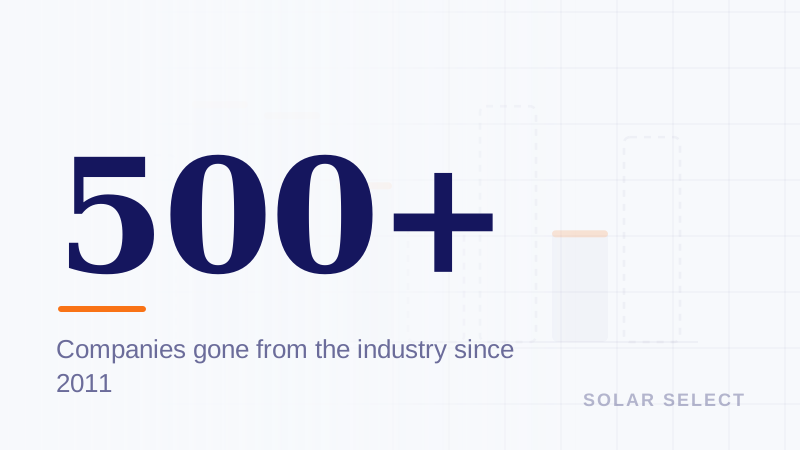
- ASIC records indicate more than 500 companies have left the Australian solar industry since 2011, with more exiting through the current boom.
- When an installer collapses, manufacturer product warranties survive — they are with the manufacturer, not the installer.
- The workmanship warranty generally does not survive. That is the one covering the labour: mounting, cabling, roof penetrations, and anything that leaks or comes loose.
- Systems left this way are commonly called "orphaned" — the equipment works, but nobody is contractually responsible for the installation.
- A 10-year workmanship warranty from a two-year-old company is a promise with nothing standing behind it.
Two warranties, two very different fates
Almost every solar system comes with warranties that sound similar and behave completely differently when the installing company stops trading.
The product warranties — panel performance, panel product, inverter, battery — are contracts with the manufacturer. If your installer disappears, those obligations remain with the manufacturer, provided the manufacturer still exists and has an Australian presence. Panels commonly carry 25-year performance warranties on this basis.
The workmanship warranty is a contract with the installer. It covers the labour: the mounting system, the roof penetrations, the cable runs, the switchboard work, the commissioning. When the installing company is deregistered or goes into liquidation, there is no counterparty left. The warranty document remains; the obligation does not.
This asymmetry matters more than it first appears, because the workmanship items are the ones most likely to cause an expensive problem. A panel rarely fails. A badly sealed roof penetration leaks.
“The panels are warranted by a manufacturer. The holes in your roof are warranted by whoever drilled them.”
How common is it?
ASIC records indicate more than 500 companies have left the Australian solar industry since 2011 — through liquidation, administration or deregistration. Industry trackers that cross-reference ASIC insolvency notices against installer registrations put the number of collapsed businesses through the recent boom in the hundreds, with a large number of households affected.
Precise national totals should be treated with some caution: they depend on how a "solar company" is defined and how partial exits are counted. What is not in doubt is the pattern. Solar has had unusually high business turnover for a category selling 25-year products, and the current battery boom is producing the classic conditions for another wave of exits — rapid entry, thin margins, aggressive pricing, and a demand spike that will eventually normalise.
What happens to you if it occurs
If the company that installed your system stops trading, the practical position is as follows.
- Your system keeps working. A collapse is a commercial event, not a technical one.
- Manufacturer warranties remain claimable, but you will usually need to arrange your own installer to diagnose and replace, and pay that labour yourself.
- Workmanship issues become your cost. Leaks, loose mounting, cabling faults and commissioning errors have no warranty counterparty.
- You may be an unsecured creditor for any deposit paid on incomplete work — which in practice usually means recovering little or nothing.
- Another installer can take over servicing, but many are reluctant to assume liability for someone else’s installation, and some will decline.
You can check whether a company has entered external administration through ASIC’s published insolvency notices. It is a free search and worth doing before you sign, not only after something goes wrong.
How to reduce the risk before you buy
You cannot guarantee any business will still exist in ten years. You can substantially improve the odds, and the checks are quick.
- Trading history. How long has the entity actually been trading — not the brand, the registered company? A business that has survived multiple market cycles has demonstrated something a new entrant cannot.
- The entity on the contract. Check the ABN and company name on the quote against the one on the warranty. Some groups trade through a series of short-lived entities.
- Accreditation. Solar Accreditation Australia accreditation, held for battery work specifically where relevant, is a baseline rather than a differentiator — but its absence is disqualifying.
- Price realism. A quote well below the market is often being funded by margin that does not exist. Businesses that price below cost to win volume are the ones that fail.
- Local presence. A business with a physical local presence and a service team has more to lose from a bad install than a call centre subcontracting to whoever is available.
Why this is the argument for choosing carefully
The Australian solar market has spent fifteen years training households to compare on price. Comparison sites, three-quote rules and lowest-bid instincts all push the same way, and the result is a category where the cheapest quote frequently comes from the business least able to honour what it promises.
The costs of that show up years later and never in the comparison. A workmanship warranty you cannot claim. A rectification you pay for. A roof leak traced to a penetration sealed by a company that no longer exists.
This is also why installation quality data matters so much. The Clean Energy Regulator’s battery inspection programme found roughly 62% of inspected installations substandard through the rebate’s first year. Most of those are rectifiable defects — but rectifiable by whom, and at whose cost, depends entirely on whether the installing business is still trading when the problem surfaces.
“The cheapest quote can sometimes be your most expensive quote.”
If it has already happened to you
An orphaned system is not a write-off, and the practical steps are straightforward.
Gather whatever documentation you have — invoice, serial numbers, commissioning records, warranty certificates. Manufacturer claims are much easier with them and considerably harder without.
Contact the manufacturers directly for the panels, inverter and battery. Their obligations are unaffected by your installer’s status, though you will need to organise and fund the labour.
Find a local installer willing to take on servicing, and be upfront that the original installer is gone. Some will decline; the ones that accept will usually want to inspect the system first, which is reasonable and worth paying for.
If a deposit was paid for work never completed, register as a creditor with the appointed administrator. Recovery is often minimal, but registering costs little.
What this means for you
If you’re a homeowner
- Check the trading history of the actual company on your contract — not the brand, the registered entity with the ABN.
- Search ASIC’s published insolvency notices before signing. It is free and takes a minute.
- Understand that manufacturer warranties survive a collapse and workmanship warranties generally do not. The workmanship items are the expensive ones.
- Treat a quote well below the rest of the market as a risk signal about the business, not a bargain.
If you’re an installer
- Trading history and local presence are genuine competitive assets against low-price entrants, and homeowners are increasingly aware of why they matter.
- Being explicit about which entity carries the workmanship warranty — and how long it has traded — pre-empts the comparison a cautious buyer is already making.
- Servicing orphaned systems is a real revenue line, but scope the liability boundary in writing before taking on someone else’s installation.
Read next
Sources
Every quantitative claim on this page traces to one of the sources below — government, regulator, market operator, or independent industry reference.
We use AI to help research and draft. Claims are traced to the sources below and dated. Where we haven’t got a source, we say so on the page — treat that as a starting point and do your own research.
Ready to compare quotes? Postcode in, up to 3 vetted installers out. Free for homeowners, no obligation. All solar news · Solar guides · How it works