Market data
Virtual power plants hit 900MW. What does joining one actually pay?
Around one in three Australian battery owners is now enrolled in a VPP. The earnings are real, they vary enormously by state, and the fine print is where the difference lives.
· 7 min read · Last verified 2026-08-11
The 30-second take
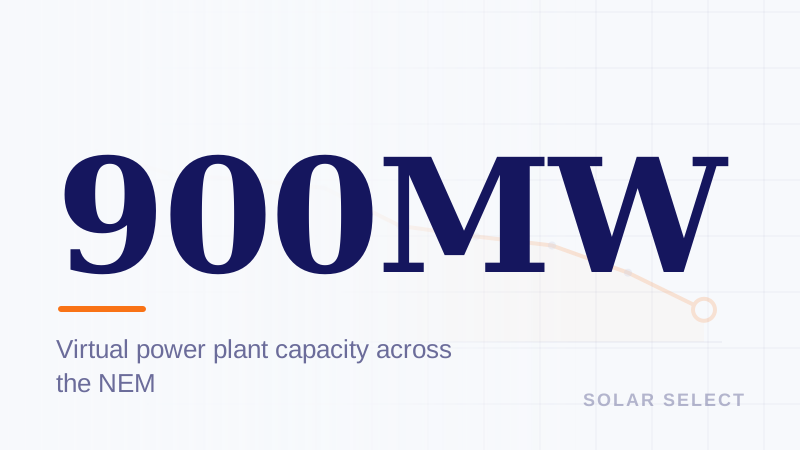
- VPP capacity reached 900MW across the National Electricity Market by Q1 2026, up from roughly 350MW in early 2024.
- As at June 2026, around ten providers were running active VPP programs, with roughly one in three battery owners enrolled in some form.
- Typical earnings run $200–$1,000 a year, depending on state, battery size and provider.
- South Australia consistently pays best — commonly quoted at $500–$1,000+ — with $300–$600 more typical in Victoria, Queensland and New South Wales.
- The headline rate is the least important term. Cycle limits, control rights and exit conditions decide what you actually keep.
What a VPP actually is
A virtual power plant is an agreement that lets an energy company draw on your home battery at times when the grid needs power, in exchange for payment.
Instead of your battery only serving your own house, it joins a fleet of thousands of batteries that the operator can discharge together during evening peaks or grid events. Aggregated, those thousands of small batteries behave like one large generator that can respond in seconds.
For the grid, that is valuable — it is fast, distributed, and already built. For you, it is a second income stream from an asset you bought for a different reason.
The growth curve reflects that value. VPP capacity across the NEM went from roughly 350MW in early 2024 to around 900MW by the first quarter of 2026, with about ten providers running active programs and roughly a third of battery owners participating.
What it pays, and why the state matters so much
Typical household earnings sit between $200 and $1,000 a year. That is a wide range, and the biggest single determinant is which state you are in.
South Australia is consistently at the top — commonly quoted around $500 to $1,000 or more — because SA has the highest renewable penetration in the NEM and the most volatile evening pricing. Volatility is what a VPP monetises. Victoria, Queensland and New South Wales more typically land in the $300 to $600 range.
Battery size matters too, but less than people expect. Most programs cap how much they will draw per event and how many events they will run, so a very large battery does not earn proportionally more than a mid-sized one.
“VPPs monetise volatility. That is why South Australia pays the most and it has nothing to do with sunshine.”
The terms that actually decide your outcome
Comparing VPPs on the headline annual figure is the equivalent of comparing solar quotes on the total price. It is the visible number and it is not the one that determines what you get.
- Cycle limits. How many times a year can the operator discharge your battery? Every cycle uses warranty life. A program that pays well but cycles hard is spending an asset you paid for.
- Reserve level. How much charge are you guaranteed to keep? If the operator can empty your battery during a heatwave, your backup capability is theoretical.
- Control rights. Can you override an event? Some programs allow opt-outs, some allow a limited number per year, some do not allow any.
- Warranty interaction. Does participation affect the manufacturer’s warranty, and does the operator cover the difference? Get this in writing.
- Tariff bundling. Many programs require you to move to the operator’s electricity plan. A good VPP payment on a poor tariff can leave you worse off overall.
- Exit conditions. Lock-in periods and exit fees vary widely, and the market is changing fast enough that a three-year lock-in is a real cost.
How to work out whether it is worth it for you
The honest calculation compares three things, and it takes a spreadsheet rather than a brochure.
First, the VPP payment. Second, what those cycles cost you in battery warranty life — most warranties are expressed in throughput or cycles, so the operator’s use of your battery genuinely consumes something you own. Third, whether the required electricity plan is better or worse than what you would otherwise choose.
For a household in South Australia with a mid-sized battery and a program with sensible cycle limits, the answer is usually clearly yes. For a household in a low-volatility region, on a program with aggressive cycling and a mandatory tariff that is worse than the market, it can be marginal.
The useful thing is that this is a reversible decision in a way most energy choices are not. If a program disappoints, you can generally leave at the end of the lock-in period and the battery keeps working exactly as before.
Check compatibility before you buy the battery
The mistake worth avoiding is buying a battery first and thinking about VPPs later.
Programs have equipment requirements. Some are open to a broad range of batteries, some to a specific list, and at least one major program is restricted to a single manufacturer’s hardware. Programs also set minimum and maximum capacities.
If VPP income is part of how you are justifying the purchase, then compatibility with the programs available in your state is a specification, not an afterthought. Ask your installer which programs the system they are quoting can join in your postcode, and get the answer before you sign rather than after the battery is on the wall.
What this means for you
If you’re a homeowner
- If VPP income is part of your business case, confirm which programs your proposed battery can actually join in your postcode before you sign.
- Compare cycle limits, reserve levels and control rights — not just the headline annual payment. Cycles consume warranty life you paid for.
- Check whether the program requires a specific electricity plan, and price that plan against what you would otherwise choose.
- Expect $200–$1,000 a year depending on your state. Treat anything promising much more as a claim to verify.
If you’re an installer
- VPP compatibility is now a specification customers care about. Knowing which programs accept which hardware in your service area is a concrete sales advantage.
- Being upfront that cycling consumes warranty throughput builds credibility, and it is a conversation the customer will otherwise have with someone else later.
- Households justifying a battery partly on VPP income need the numbers modelled honestly. Overstated VPP earnings are a common source of post-install disappointment.
Read next
Sources
Every quantitative claim on this page traces to one of the sources below — government, regulator, market operator, or independent industry reference.
We use AI to help research and draft. Claims are traced to the sources below and dated. Where we haven’t got a source, we say so on the page — treat that as a starting point and do your own research.
Ready to compare quotes? Postcode in, up to 3 vetted installers out. Free for homeowners, no obligation. All solar news · Solar guides · How it works