Market data
Wholesale power just hit a six-year low. Your bill did not.
Renewables supplied 42.1% of the National Electricity Market in the June quarter and wholesale prices fell 47% year on year. The gap between that and your retail bill is worth understanding.
· 6 min read · Last verified 2026-08-11
The 30-second take
- Renewables supplied 42.1% of NEM electricity in the three months to June 2026, a new second-quarter high.
- Distributed PV output hit a record Q2 average of 2,520MW, up 6.9% year on year, taking its share to 10.3% for the quarter.
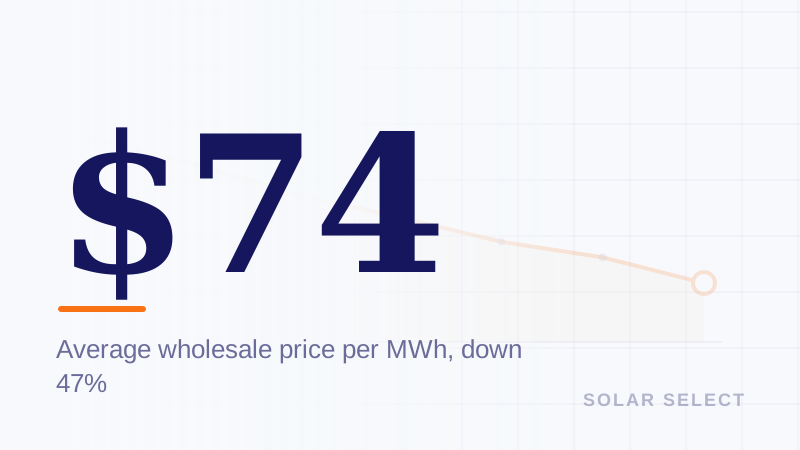
- NEM-wide wholesale spot prices averaged around $74/MWh, down 47% from Q2 2025 and the lowest Q2 average since 2020.
- More than 700MW of rooftop solar was added across April to June.
- Wholesale is roughly a third of a retail bill. A 47% wholesale fall does not produce a 47% bill fall.
What the quarter showed
AEMO’s Quarterly Energy Dynamics report for the three months to June 2026 recorded renewables supplying 42.1% of National Electricity Market generation — a new record for a second quarter, which is the seasonally hardest quarter for solar in Australia.
Distributed PV — rooftop solar on homes and small businesses — averaged a record 2,520MW across the quarter, up 6.9% year on year, lifting its share of the energy mix to 10.3%. More than 700MW of new rooftop capacity was added during the quarter.
The price consequence was substantial. NEM-wide wholesale spot prices averaged around $74 per megawatt-hour, down 47% from the same quarter in 2025 and the lowest second-quarter average since 2020.
Why a 47% wholesale fall is not a 47% bill fall
This is the question every household asks when these numbers get reported, and the answer is genuinely useful to understand rather than a dodge.
The wholesale price is what retailers pay for the energy itself. It is only one component of your bill, and typically around a third of it. The rest is made up of network charges for the poles, wires and substations that deliver the energy, environmental scheme costs, retailer operating costs and margin, plus GST.
Network charges in particular are regulated on multi-year determinations and do not move with the spot market at all. So even a dramatic wholesale fall passes through to retail bills in a diluted and delayed way.
- Wholesale energy — roughly a third of the bill, and the part that fell.
- Network charges — regulated, set on multi-year cycles, unmoved by spot prices.
- Environmental schemes — the cost of renewable and efficiency programs.
- Retail costs and margin — the retailer’s own operating expenses.
That said, the fall did show up. The Default Market Offer for 2026–27 cut residential flat rates by roughly 3% to 7% in New South Wales and south-east Queensland from 1 July, with the AER naming lower wholesale costs as one of three drivers. That is the wholesale decline reaching your bill — just muted by everything else in it.
What cheap wholesale power does to solar economics
There is an uncomfortable implication for solar owners in these numbers, and it is better to face it directly than to be surprised by it later.
Feed-in tariffs are ultimately anchored to the wholesale value of the energy you export. When wholesale prices fall 47%, the economic basis for paying you a decent feed-in rate weakens accordingly — and midday, when your system exports most, is exactly when the abundance is greatest and prices are lowest.
So the same trend that lowers your retail bill also lowers what your exports earn. For a solar household these partly offset, but not evenly: you export at the cheapest time of day and buy across all times, so the bill reduction is generally worth more than the export loss.
The way to escape the asymmetry is to stop exporting at the cheap time. That is what a battery does — it holds the midday surplus and releases it in the evening, when the grid is short and the value is high.
“You export when energy is cheapest and buy when it is not. That asymmetry is the whole argument for storage.”
The seasonal detail worth noticing
A second-quarter record deserves a footnote, because Q2 in Australia covers April, May and June — the shortest days and the weakest solar of the year.
Distributed PV reaching a record 2,520MW average and 10.3% of the mix in the winter quarter says something about how much rooftop capacity is now installed. In the summer quarter, rooftop solar routinely runs at a much higher share.
For a household, the practical version of this is that a system sized on annual averages will substantially overproduce in summer and underproduce in winter. If your goal is to cover most of your consumption year-round, the sizing conversation should be about winter output rather than annual totals — and that is the conversation a good installer will start without being asked.
What this means for you
If you’re a homeowner
- Do not expect retail bills to track wholesale prices. Energy is only about a third of the bill; network charges do not move with the spot market.
- Falling wholesale prices weaken the case for export income and strengthen the case for storage and self-consumption.
- Size your system against winter output if you want year-round coverage. Annual averages hide the seasonal gap.
- Check whether a time-of-use plan now suits you better — cheap wholesale periods increasingly show up as cheap retail windows.
If you’re an installer
- Customers reading about six-year-low wholesale prices will ask why their bill has not halved. Being able to break down the bill components quickly builds trust.
- Winter-output-based sizing is more honest than annual-average sizing and produces fewer disappointed customers in July.
- The wholesale trend is a structural argument for storage. It is more durable than a rebate-deadline pitch and it does not expire.
Read next
Sources
Every quantitative claim on this page traces to one of the sources below — government, regulator, market operator, or independent industry reference.
We use AI to help research and draft. Claims are traced to the sources below and dated. Where we haven’t got a source, we say so on the page — treat that as a starting point and do your own research.
Ready to compare quotes? Postcode in, up to 3 vetted installers out. Free for homeowners, no obligation. All solar news · Solar guides · How it works